by Marcela M. | Oct 2, 2012 | Blog, Parties, Uncategorized
Good evening friends! I hope you had a lovely weekend!
I write this post late in the evening because today was a holiday, Cyprus Independence Day, so we took advantage of having Luka and Zoe home for an extra dose of playing, crafting and cooking together. I try to spend as little time as possible in front of the computer when they are home (I don’t always manage, but I try!).
Now on to today’s post: Luka and Zoe’s 4th birthday party!
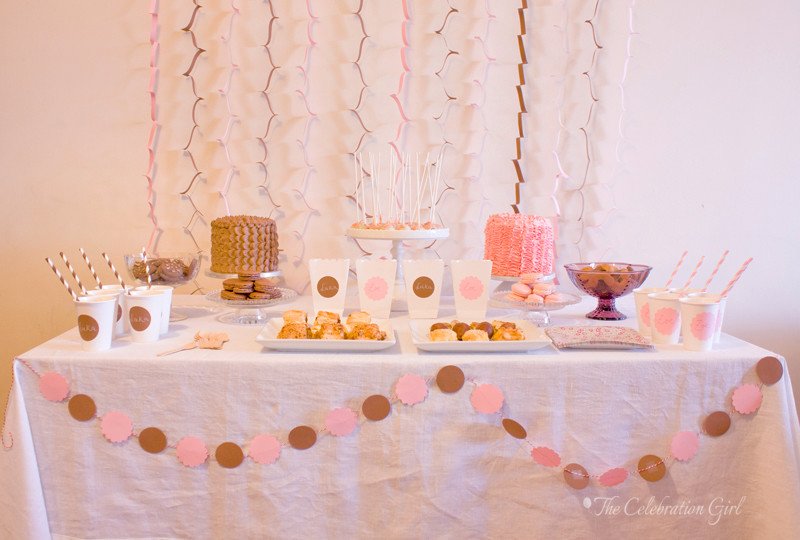
If I had to chose one word to describe the party, it would be relaxed. Unlike other birthdays, for this one we decided to take it easy, not only on the day itself, but also during the preparations. This year there was no rush, no late night crafting, no stressing over little details. We did our best to give our children a pretty little home party that was within our budget; and we made a conscious decision to make our best for Luka and Zoe to enjoy, not only the party itself, but also the weeks before it.
Let me explain this a little better. Earlier this year, I mentioned to my husband a comment a friend had made to me, about how her child was always cranky and hypersensitive the week prior to his birthday, and I noticed that the same had happened with our children the week prior to their last party. “Of course children get cranky and hypersensitive” said my husband, and then explained his thoughts: “The week before these parties mothers go crazy with all the preparations, and children at this age don’t really understand what it all is about, nor do they care, so they get nervous.” This got me thinking a lot about how we celebrate and about how we honour the persons in our life, and I realized how easy it is to slip into the mistake of doing things that, while beautiful, are not really for the ones we intend to honour, but for ourselves. So we made the commitment to follow our children’s lead as to what they want(and then adapt that to be within our means, of course) to have them participate in the preparations as much as possible, and to be mindful about the fact that in every celebration, little or big, it is the memories we built that matter. We decided to make an extra effort to build memories that are happy from beginning to end, memories that are untarnished by unnecessary stress or arguments over minor details.
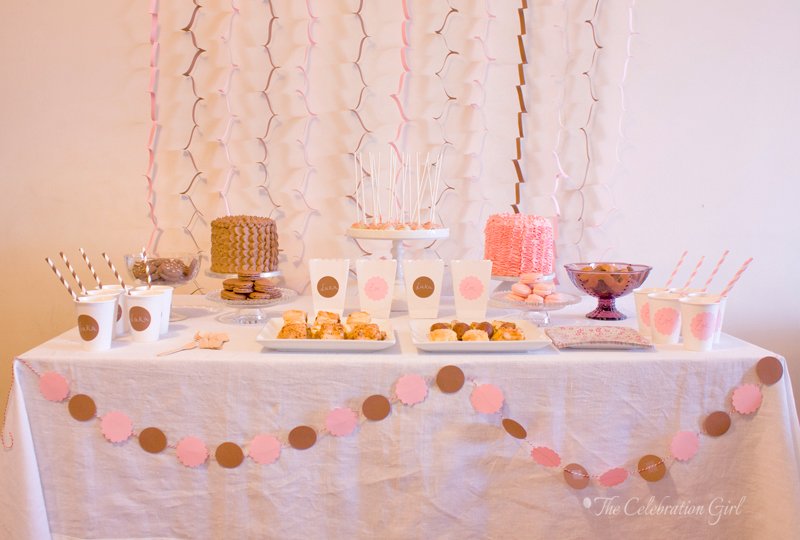
We started by setting up a stress-free birthday preparation plan of action, for which my natural A-type personality behaviour came in handy (wink, wink). Luka and Zoe didn’t really care about anything else than there being a cake with candles they could blow over and over so, without a theme chosen by themselves, I decided to make one based only on flavours they love: vanilla, strawberry, and chocolate, lots of chocolate. This lead to a simple color palette: brown and pink, with a white/creme base. With this in mind, I checked what I already had at home to set the table (I had almost everything. The only thing I had to buy were the popcorn boxes) and prepared a menu based on the number of persons that we knew we would invite, which was very small because Luka and Zoe’s birthday falls the middle of the Summer vacations.
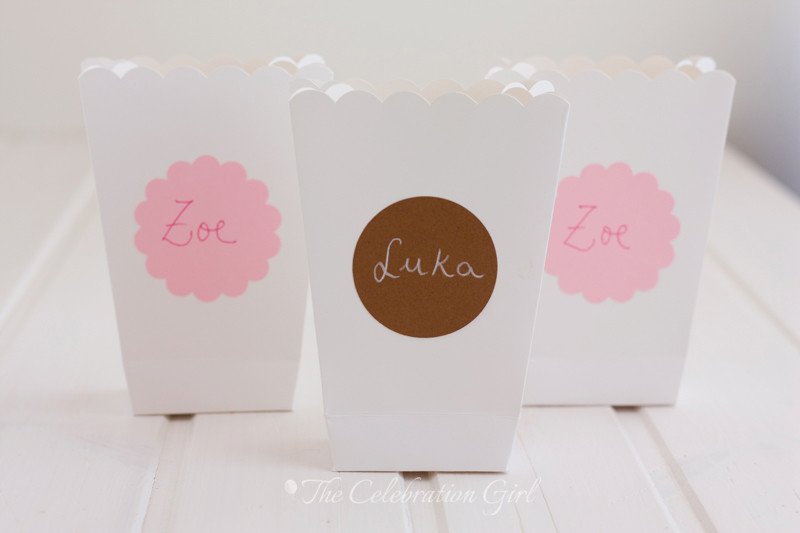
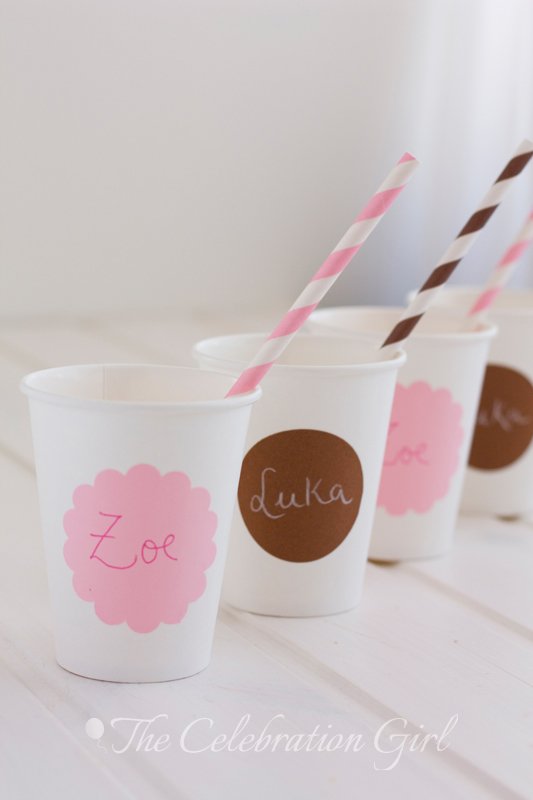
One month before the party, while Luka and Zoe were in Summer school, I baked the macarons, and froze them. Three weeks before the party, I baked the cakes and froze them too, wrapped in two layers of foil. One week before the party, I prepared the cakes’ frostings and froze them as well. Two nights before the party, I prepared the streamers for the backdrop, the garland for the dessert table, and I punched and glued the circles that I used to personalize paper cups and popcorn boxes. The day before the party, I defrosted all food, made the cake-pops, assembled the cakes including crumb coating and, on the night before, I decorated them in no more than one hour.
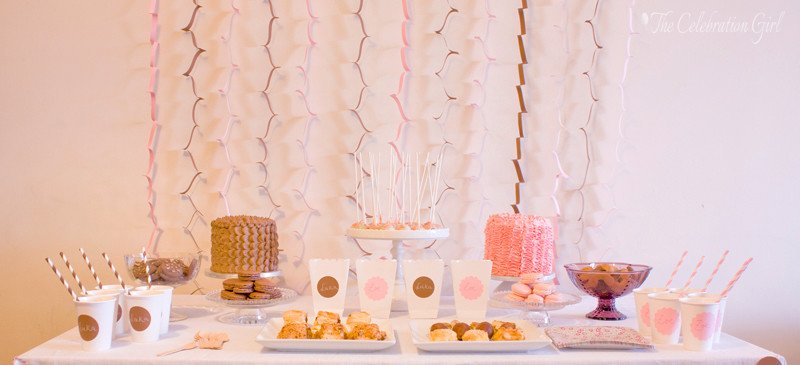
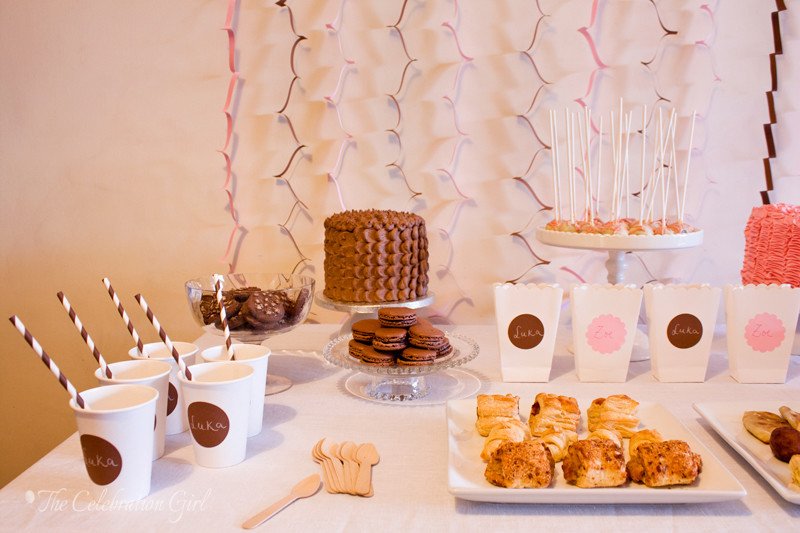
Two hours before the party, we bought a few petits fours at a local bakery. One hour before the party, while Luka and Zoe were playing by my side, I set up the backdrop (using double sided tape) and all dishes. 15 minutes before the beginning of the party, I placed the food and took a few pictures. Here’s a look at how the table looked before and after the food was added:
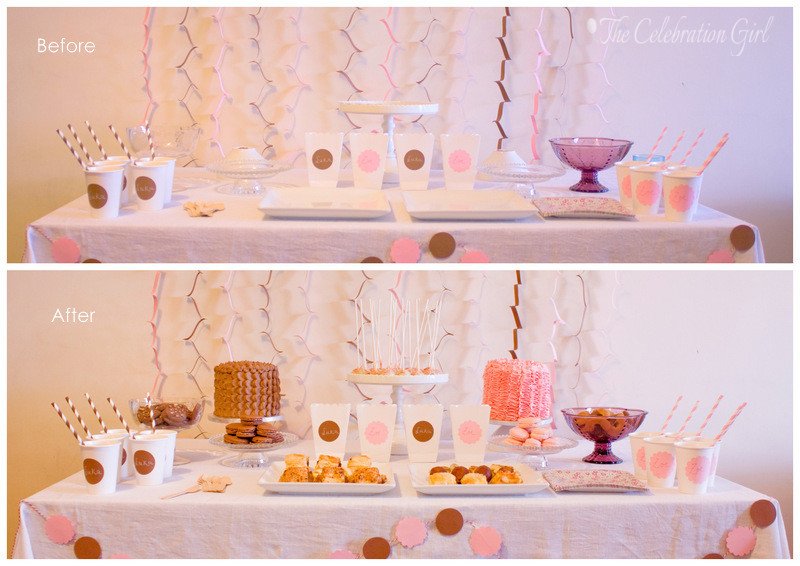
If you look closely, you will see that I used a few “tricks’: The cakes were placed on a cake drum on top of inverted white bowls (I don’t own small cake stands) and the cute glass cake stands where the macarons were placed? They are dessert plates placed on top of matching bowls, glued together with a little piece of play-dough so that they would be safe for little hands!
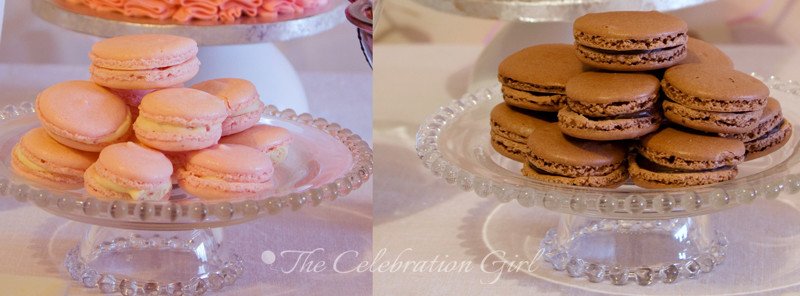
The food consisted of the above said petits-fours (in different flavours), chocolate macarons with dark chocolate ganache, rose macarons with white chocolate and strawberry ganache, chocolate cake pops (covered in white chocolate and drizzled with pink chocolate-Sorry there are no pictures!), Luka and Zoe’s favourite cookies (Pan di Stelle and Abracci), popcorn, and the birthday cakes.
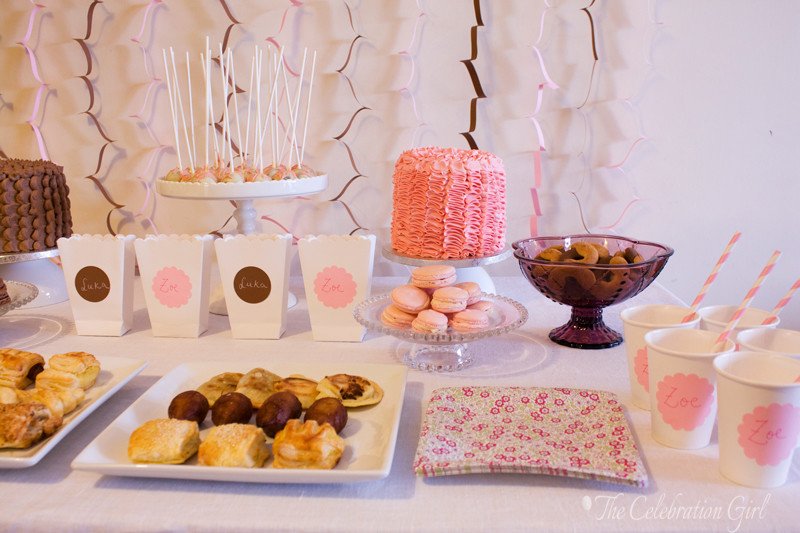
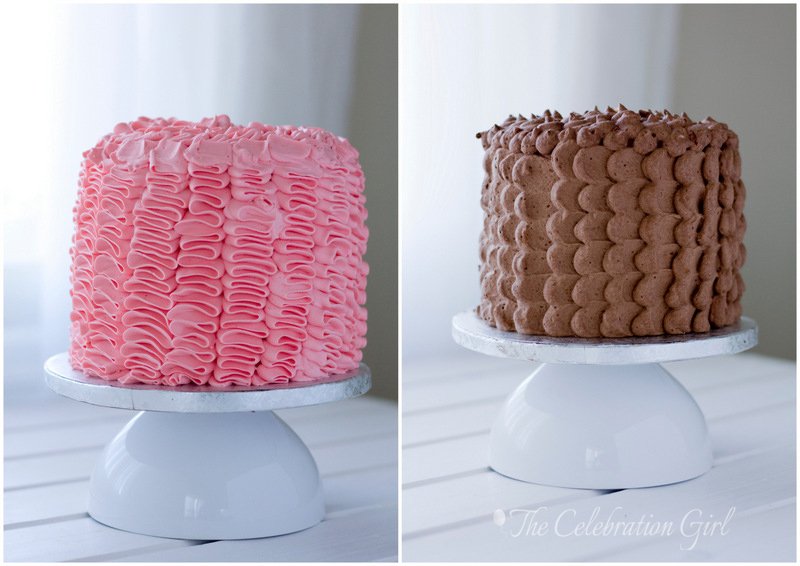
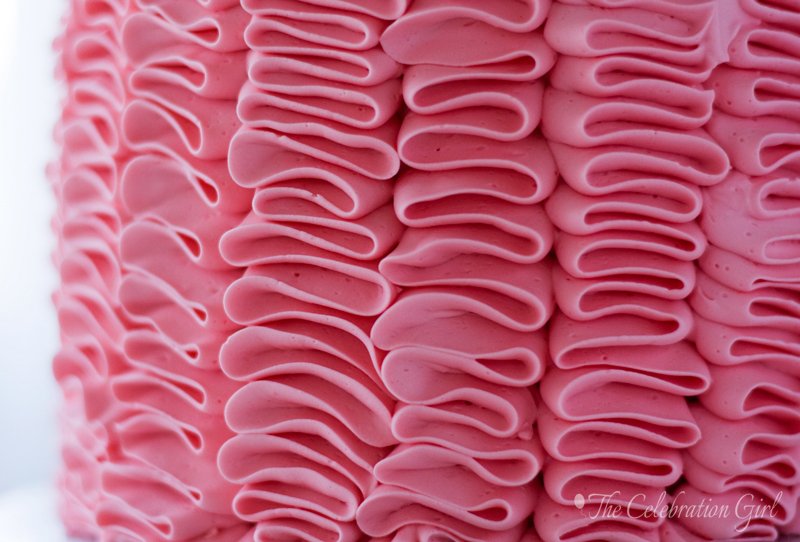
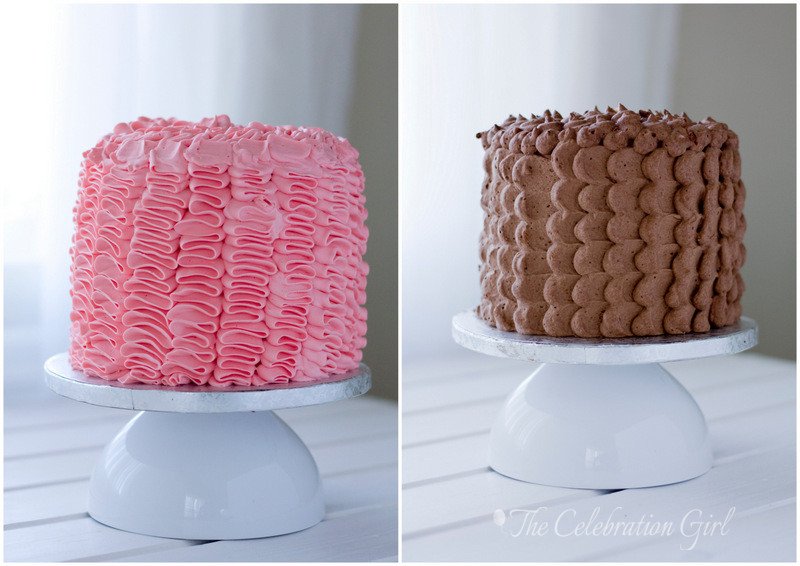
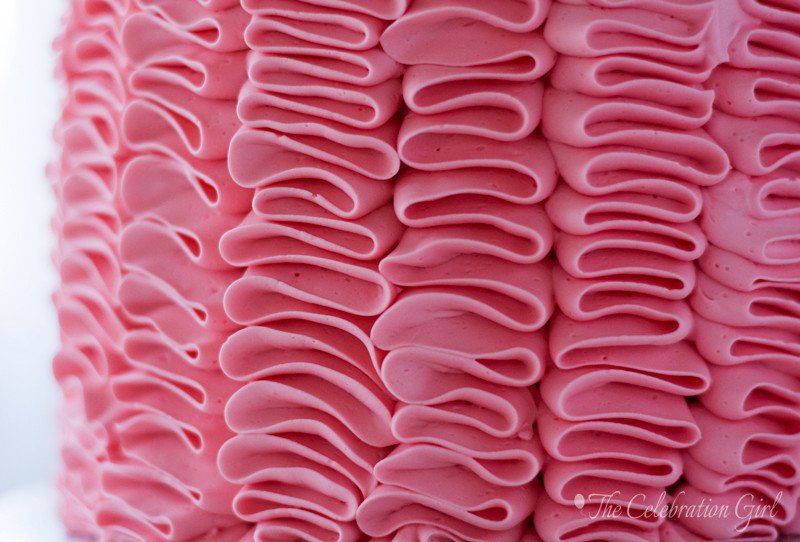
Zoe’s cake was made of layers of vanilla and strawberry cake filled and frosted with tons and tons pink vanilla bean swiss meringue buttercream ruffles. You can see how to make the ruffles watching THIS video by My Sweet and Saucy. It is really, really easy and fast!
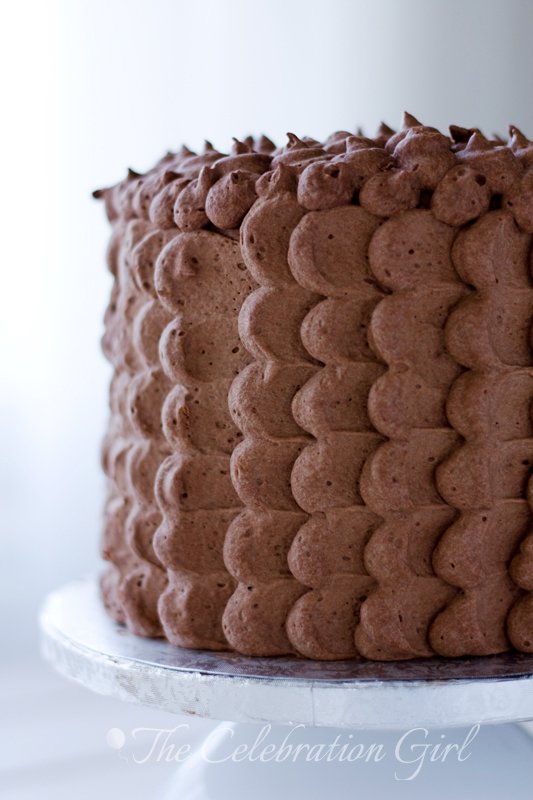
Luka’s cake was made of layers of a very moist chocolate cake, filled and frosted with semi-sweet chocolate swiss meringue buttercream. For the decoration, I used the petal technique, which has been all over the web these past months and that you can learn by reading THIS tutorial by My Cake School. It is a little more time consuming than the ruffles, but just as easy.
You probably noticed that the pictures are…well, not my best. I had decided not to over stress about them before the party (not to stress Luka and Zoe out) and, during the party, in the middle of it all, a few funny things happened. If you follow me on facebook, you already know what that is, but if you don’t, here’s the status message I published at the time: Instructions for candle blowing with 4 year old children: 1) Innocently believe that it will be possible to light 8 candles with two 4 year old kids waiting patiently to blow them, despite this being the first birthday when they actually realize what is going on and are super excited 2) Set up the camera on a tripod in a hurry, while trying to keep said children away from the tripod and, mostly, from the camera. 3) Accidentally set incorrect speed settings, thereby causing all pictures to be blurred.4) Try to light candles in one cake first 5) Watch both children blow vigorously from below, turning off the candles as soon as they are lit 6) Realize that no matter which settings you chose, your children are blowing the candles so quickly that the continued shooting did not have time to even start taking pictures before all candles were blown.7) Quickly, grab a child and put her next to the cake to try to “fake”a picture, while the other child runs around asking “again! again!”. 8) Light the candles of the second cake, grab the children and their friend (who also wants to blow candles!) and make a last attempt 9) Enjoy the happy chaos and everybody’s laughter and forget about whether anyone will be able to distinguish anything from the pictures 😉
Have a wonderful day!
Con sabor latino…
Buenas noches queridos amigos! Espero que hayan tenido un fin de semana hermoso!
Escribo este post tarde por la noche porque hoy fue feriado, el día de la Independencia de Chipre, así que aprovechamos que Luka y Zoe estaban en casa para tener una dosis extra de mimos, juegos, manualidades y cocina juntos. Cuando ellos están en casa intento no acercarme a la computadora…no siempre lo logro, pero lo intento!
Ahora sí, hablemos del post de hoy: el cuarto cumpleaños de Luka y Zoe!
Si tuviera que describir la fiesta con una sola palabra, sería relajada. A diferencia de otros cumpleaños, este decidí tomar todo con calma, no sólo el día de la fiesta, sino tambien durante los preparativos. Este año no hubo corridas, manualidades hasta altas horas de la noche ni stress por pequeños detalles. Hicimos todo lo posible para darle a nuestros hijos una fiesta casera y bonita, dentro de nuestro presupuesto, y tomamos la decisión consciente de esforzarnos por que Luka y Zoe disfrutaran, no sólo de la fiesta en sí, sino tambien de las semanas anteriores a la misma.
Dejenme explicarles un poco mejor a qué me refiero con ésto. A comienzos de este año, le mencioné a mi marido el comentario que una amiga me había hecho, acerca de cómo su hijo siempre se ponía nervioso y estaba hiper sensible durante toda la semana antes de su fiesta, y cómo yo había notado lo mismo en nuestros hijos durante la semana anterior a su última fiestas de cumpleaños, que celebramos en Argentina. “Es lógico que los chicos se pongan nerviosos e hipersensibles “, me dijo mi marido, y explicó: “Justamente es en esa semana antes que las madres estan enloquecidas corriendo detras de los detalles y preparativos de las fiestas, y los chicos, que a esta edad no entienden de qué se trata, ni les importa, se ponen nerviosos”. Esto me dejó pensando mucho acerca de cómo celebramos y cómo honramos las personas importantes en nuestra vida y me dí cuenta de cuan fácil es caer en el error de hacer cosas que, aunque bonitas, no estan dirigidas a quienes queremos celebrar y honrar, sino que son hechas para nosotros mismos, porque nos gustan a nosotros, porque satisfacen un deseo nuestro y no de la otra persona. Por ello, asumimos el compromiso de dejar que nuestros hijos quienes decidan qué quieren y qué no (adaptando ésto a nuestras posibilidades, claro!), de hacerlos participar en los preparativos, y de tener muy presente que en toda celebración, grande o chica, lo que importa con los recuerdos que creamos juntos. Y nos comprometimos, tambien, a hacer un esfuerzo extra por que esos recuerdos que creamos sean recuerdos felices de principio a fin, recuerdos que no estén manchados por stress innecesario o discusiones sin importancia.
Con este objetivo en mente, armamos un “plan de acción para una fiesta de cumpleaños sin stress”, facilitado por mi personalidad tipo A ;)Luka y Zoe no querían nada especial, sólo una torta con velitas que pudieran soplar una y otra vez así que, sin un tema elegido por ellos mismos, decidí concentrarme para armar todo en sus sabores preferidos: vainilla, frutilla y chocolate, mucho chocolate. Esto llevó a una paleta de colores simple y sencilla: rosa y marrón chocolate, con una base en crema/blanco. Con esto en mente, comencé a ver qué tenía disponible en casa para servir la mesa (para mi alegría, descubrí que tenía casi todo-sólo compré las bolsas de popcorn), y planifiqué el menú en base a la cantidad de invitados, que fueron muy poquitos porque mis hijos cumplen años en plenas vacaciones de verano.
Un mes antes de la fiesta, mientras Luka y Zoe estaban en la escuela de verano, preparé los macarons y los congelé en el freezer. 3 semanas antes de la fiesta,prepará las tortas (cada capa por separado) y las congelé tambien, envueltas en doble capa de papel film. Una semana antes de la fiesta, preparé las cremas con las que rellenaría y decoraría las tortas y las congelé. Dos noches antes del día de la fiesta, preparé las guirnaldas que decorarían la pared contra la cual iría la mesa dulce, la guirnalda que iba en la mesa, y personalicé los vasos y las bolsas de popcorn con circulos de cartulina en los que escribí el nombre de mis hijos. El día antes de la fiesta descongelé toda la comida, hice los cake pops con los restos de torta que sobraron al emparejarlas, armé las tortas, incluyendo la primer capa de crema de la decoración y, la noche anterior, las decoré en no más de una hora.
Dos horas antes de la fiesta, mi marido compró unos petits fours en una panadería cercana.Una hora antes de la fiesta, mientras Luka y Zoe corrían y jugaban alrededor mío, puse las guirnaldas en la pared y coloqué la vajilla en la mesa.15 minutos antes que llegaran los invitados, coloqué la comida, y saqué un par de fotos (arriba pueden ver el antes y el despues de la preparación de la mesa dulce)
Si miran las fotos del antes y el despues detalladamente, notaran que usé un par de truquitos: como no tengo cake stands pequeños, coloqué las tortas en su base de carton sobre bowls blancos invertidos, y los macarons sobre pies de torta que en realidad no son sino platos de postre colocados sobre mini bowls haciendo juego, invertidos. Los bowls estan pegados a los platos con plastilina, que es facil de sacar y de lavar, para que no se muevan y sean seguros para pequeñas manitos toca todo.
La comida consistió en los mencionados petits fours, macarons de chocolate rellenos con ganache de chocolate amargo, macarons de rosas rellenos con ganache de chocolate blanco y frutillas, cake pops cubiertos con chocolate blanco y tiras de chocolate blanco teñido de rosa (no hay fotos, perdon!), las galletitas preferidas de Luka y Zoe (Abracci y Pan di Stelle), pochoclo y las tortas, claro.
La torta de Zoe estaba formada por capas de tortas de vainilla y frutilla, rellena y decorada con montones de volados de crema de manteca suiza a la vainilla, teñida de rosa. Para saber cómo hacer los volados pueden ver ESTE VIDEO de My Sweet and Saucy (en Ingles). Es facil y rapidísimo!
La torta de Luka estaba formada por capas de torta húmeda de chocolate, rellena y decorada con crema de manteca suiza de chocolate semi amargo. Para decorarla usé una técnica que se ha visto muchísimo en internet estos últimos meses, llamada “petalo” y que pueden aprender viendo ESTE TUTORIAL de My cake school. Si bien este método lleva un poco más de tiempo que los volados, es igualmente fácil de hacer.
Posiblemente hayan notado que las fotos de este post no son, ejem, de las mejores que he tomado. El día del cumpleaños decidí no estresarme al respecto antes que llegaran los invitados para no poner nerviosos a Luka y Zoe (siguiendo la misma linea de pensamiento que les comentaba antes). A lo largo de la fiesta, en medio de todo el caos que estos eventos son generalmente, ocurrieron un par de cosas graciosas. Si me siguen en facebook, posiblemente hayan leido el status que publiqué en esa ocasión y sepan de qué hablo, pero por si acaso no es así, aquí lo tienen: Instrucciones para soplar velitas con niños de 4 años: 1) Cree, inocentemente, que será posible encender 8 velas con dos niños de 4 años excitadísimos y esperando impacientemente para soplarlas,y justo en el primer año en que se dan cuenta de qué es un cumpleaños 2) Coloque la cámara en un trípode a las corridas, e intentando mantener a dichos niños alejados del trípode y de la cámara 3) Seleccione los parámetros incorrectos accidentalmente, causando que todas las fotos sucesivas aparezcan borrosas 4) Intente encender las velas, una torta por vez 5) Observe cómo los mencionados niños la persiguen soplando vigorosamente, apagando las velas tan pronto como usted logra encenderlas. 6) Dese cuenta que los parametros de la cámara no importan demasiado, porque sus hijos estan soplando las velas tan rapidamente que todas se han apagado antes que el modo continuo de la cámara comience siquiera a tomar fotos. 7) Rápido, tome un niño y coloquelo en posicion de soplado aunque todas las velas ya esten apagadas, para fingir una foto correcta, mientras el otro niño corre alrededor gritando, excitadísimo, “de nuevo! de nuevo!”8) Encienda las velas de la segunda torta, tome ambos niños y a su amiguita que a estas alturas tambien quiere soplar velas, y haga un último intento 9) Disfrute el feliz caos y las risas generalizadas y olvide que nadie será capaz de distinguir nada en las fotos 😉
Que tengan un hermoso día!

by Marcela M. | Sep 27, 2012 | Blog, Europe, Travel, Uncategorized
Autumn is here.
September is almost over and, while Summer is still lingering in Nicosia, some trees have started to lose their leaves, and, early in the mornings and when the sun sets at night, the air is fresh and a lovely, cool breeze signals the beginning of the new season.
I am, normally, an autumn-winter person. I thrive in cold weather, I love snow and even rain, and I have a hard time putting up with high temperatures. I have always looked forward to seeing the first yellow leaves appear in the trees, to getting cardigans and sweaters out of storage and to knowing that delicious apples and pears were going to fill the market stalls soon. But this year, something changed and it wasn’t my love for cold weather, which remains intact.
This year, perhaps for the first time, I also embraced Summer.
It may have been the fact that, for the past 7 years, I have been living in countries with warmer weather climates (first in Ivory Coast, and now in Cyprus), or it may have been the fact that this was the first year that Luka and Zoe went to school, so August felt like vacations and not just like “another hot month”. Or maybe it was because we didn’t travel and, as a consequence, we got to explore Nicosia and other parts of the island with fresh eyes, or perhaps because after a hard first half of the year (2012 has been a rough one so far), we now take every single opportunity to connect, cherish our family, and celebrate.
For whatever reason, this past Summer we slowed down, we unplugged from all the media paraphernalia, we looked around us and we made it a point to be present, to be mindful, and to take advantage of what we have, of where we live, of who we are. We wanted to make this a fun-filled summer, so I turned to Pinterest for inspiration. I had been collecting ideas for a while, and in August we put them to good use.
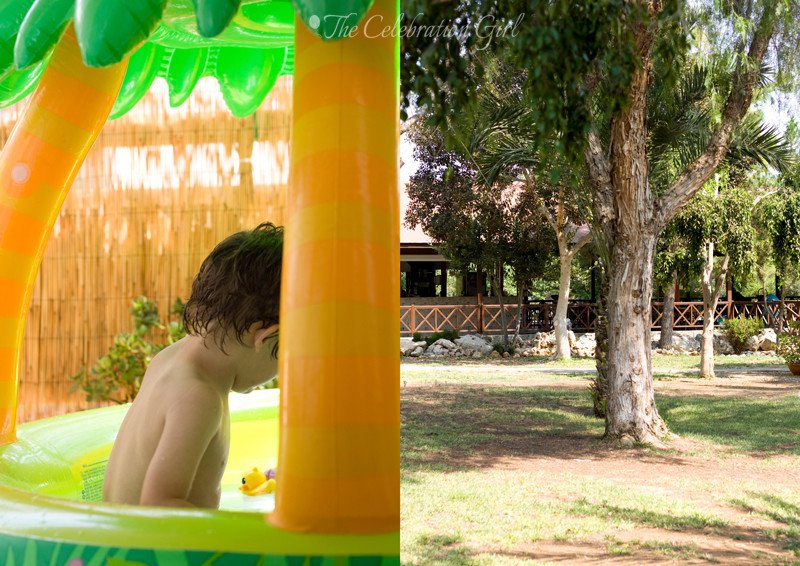
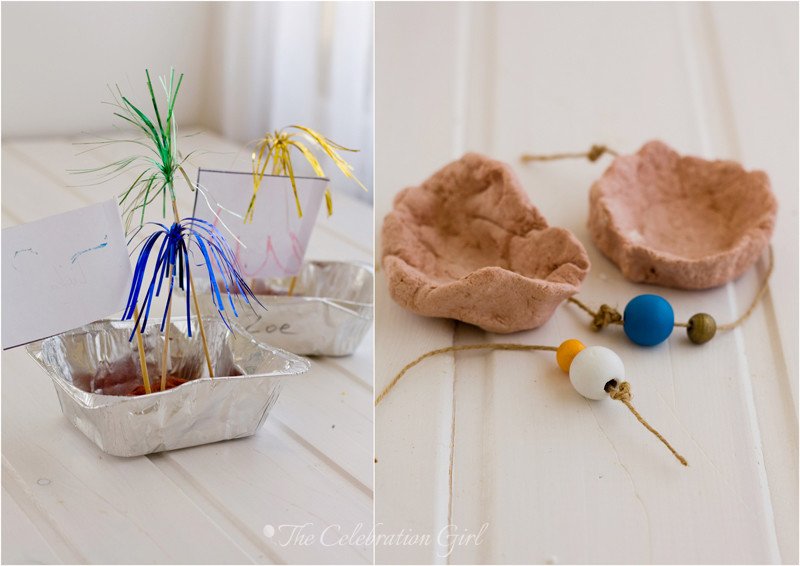
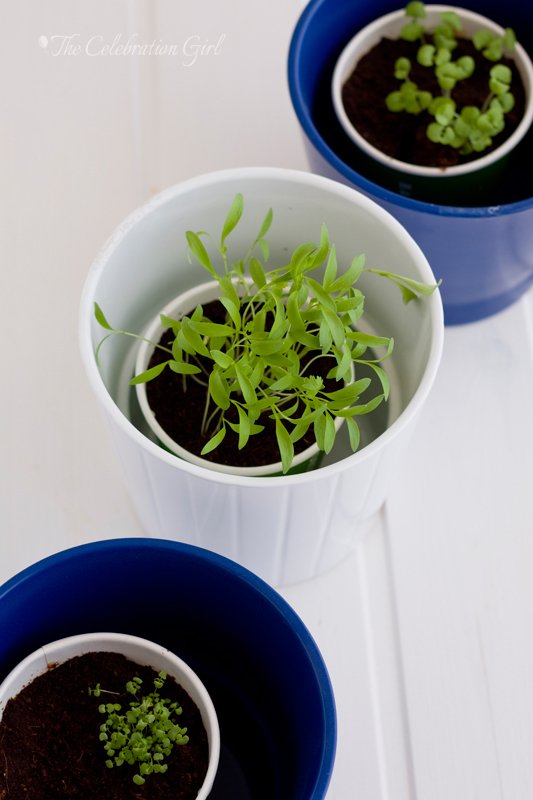
We wanted to have as much contact with nature as possible, so, at home, we planted spices to season our food. We also explored different parks and playgrounds daily, and took nature observation walks in the early hours of the morning, and then came back home to combat the heat in the paddling pool set up in the balcony. When it was too hot to get outside, we stayed indoors and spent our time doing arts and crafts. We played with clay and play-dough. We did collages and paper mobiles and hang them from the windows to twist and turn with the afternoon breeze.
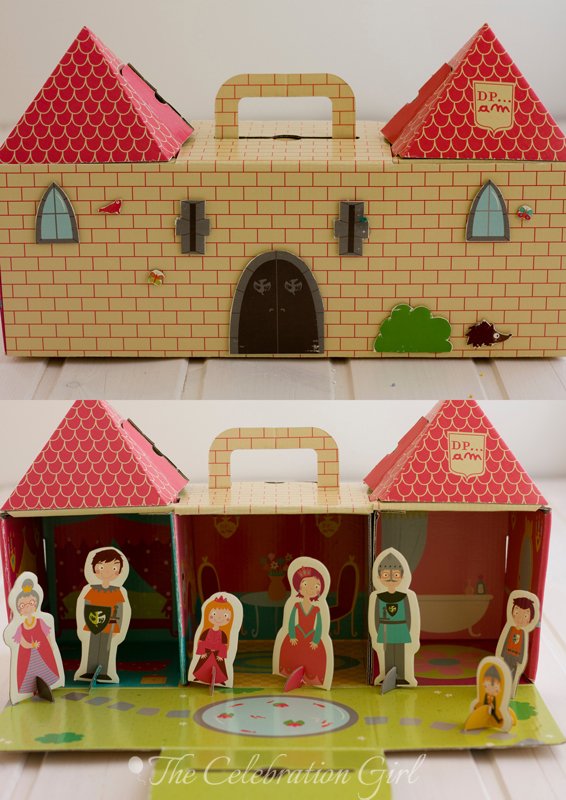
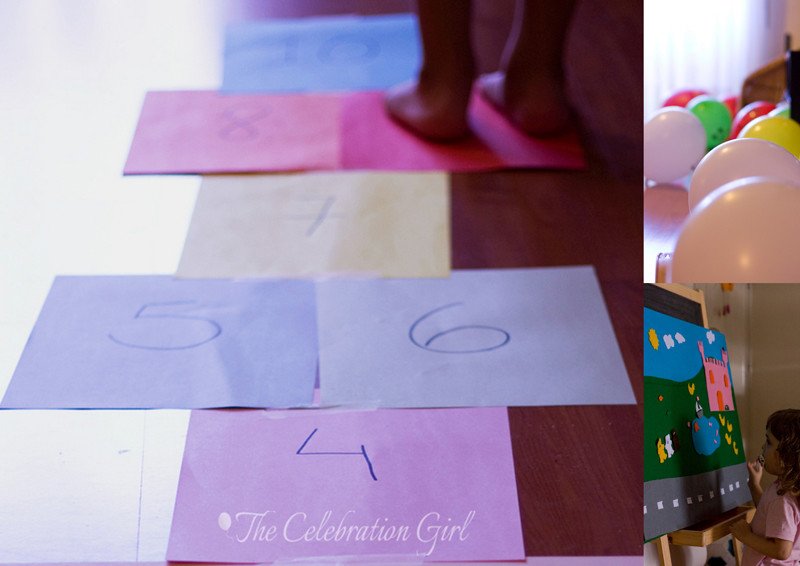
We made Toilet Tube cars, filled the house with balloons for no reason at all, glued a paper hospcotch to the floor and spent days jumping on it. We made a felt board for telling stories and singing rhymes.
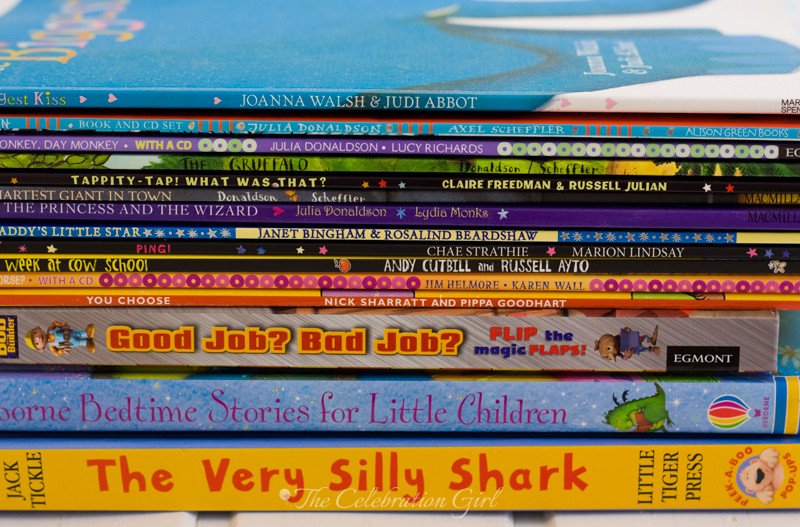
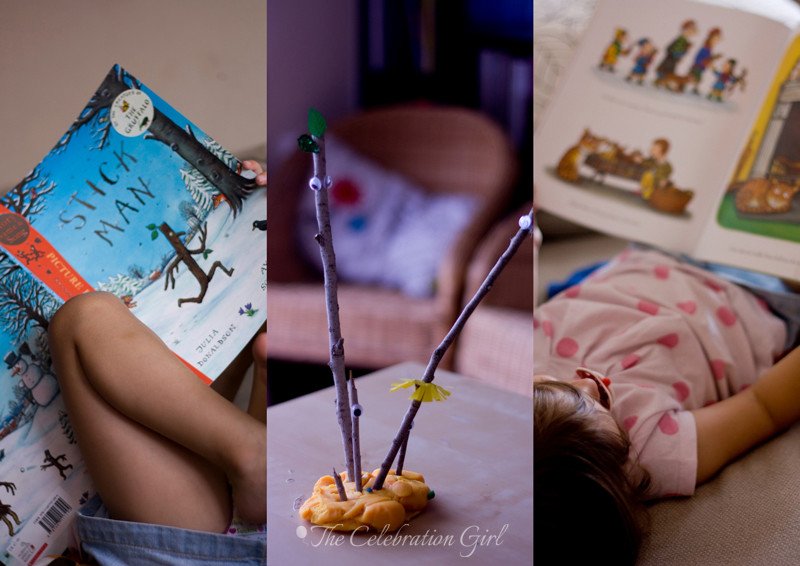
We read a lot, old and newly- discovered books, and we filled the ipod with readalong versions of our favourite stories.
We brought books to life, with a little imagination. We made lots and lots of origami boats and made them race in the paddling pool with the power of our lungs. We made origami airplanes and spent entire afternoons making them fly all around the house.
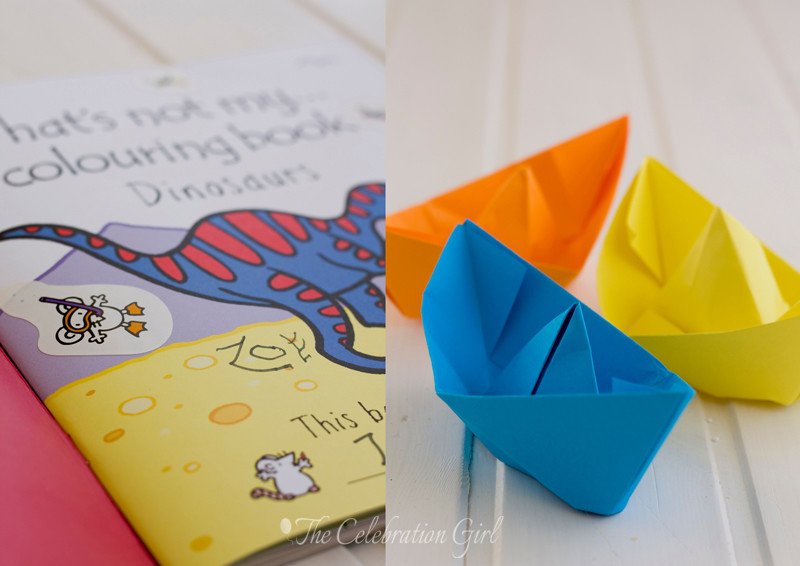
And Zoe wrote her name alone for the very first time!
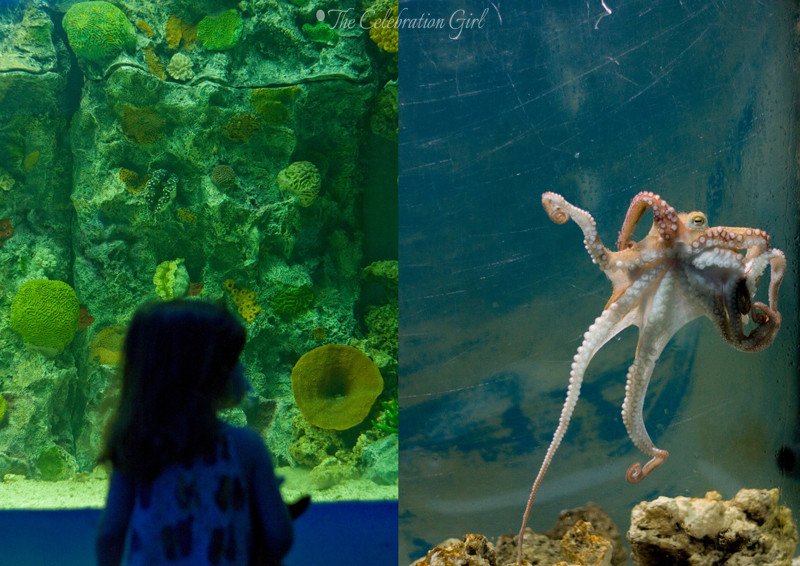
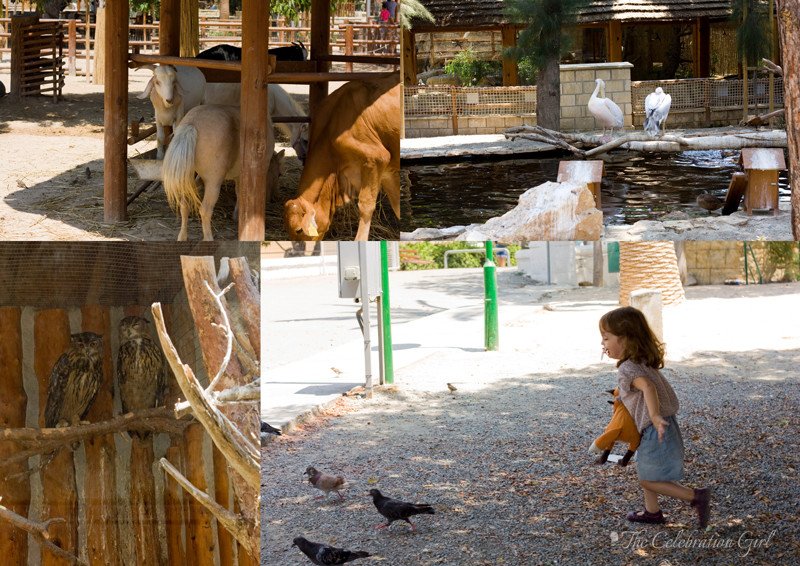
On weekends, we took day trips around the island. We visited the Protaras Aquarium, where we saw octopus, sharks, upside-down fish, penguins, pacus and many other species. We visited the Limassol Zoo, where we saw owls, monkeys, birds and even deers. We visited the Troodos Mountains and had lunch at a lovely, shaded restaurant, next to the calming sound of a stream of water where little geese and ducks were bathing.
We spent a weekend at a hotel, by the beach, and it was wonderful. We bathed and sunbathed, we played and relaxed. We saw beautiful sunsets, and the most amazing dawns from our balcony, and it all felt as carefree, peaceful and joyful as Summer should.

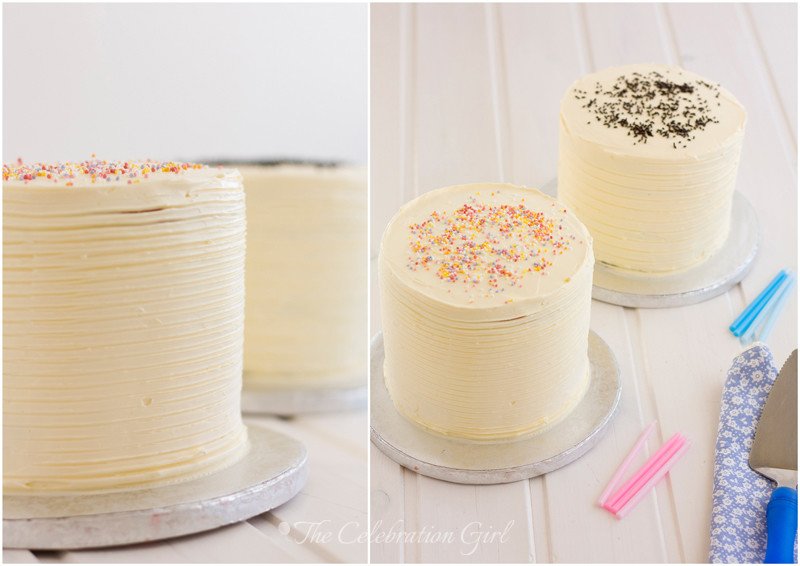
We celebrated Luka and Zoe’s birthday with not one, not two, but three cakes (each!). Yes, that’s right: one mini cake made from stacked cupcakes for the day of their birthday, one cake for each of them for a mini party at home (pictures in the next post!), and one cake for each to bring to school, to celebrate with their friends and classmates (these are cakes pictured below. Plain and simple on the outside, but with a surprise on the inside: They were rainbow cakes!).
We didn’t bake much, because it was too hot to turn the oven on…but we made ice cream! And plenty of it!
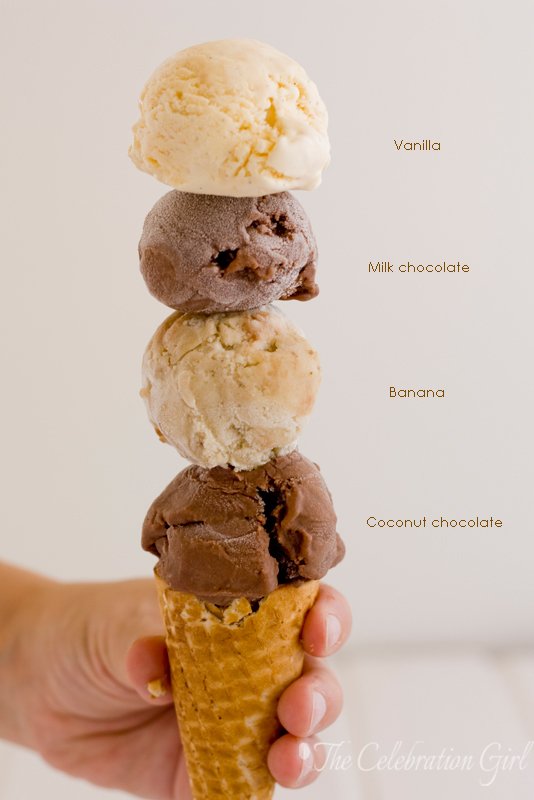
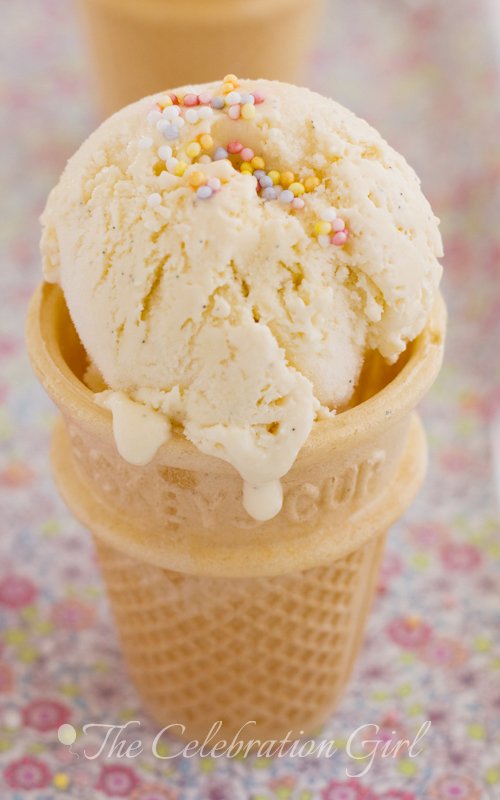
At the beginning of August, we bought the KitchenAid’s ice cream attachment and began experimenting with flavours. I turned to the internet for recipes and I was not disappointed. We made David Lebovitz’ s vanilla bean ice cream (which is AMAZING), and chocolate ice cream, the famous one ingredient banana ice cream from The Kitchn (a wonderful guilt free treat!) , and an absolutely delicious vegan coconut chocolate ice cream. We also made Food and Cook’s chocolate popsicles and her yogurt and raspberries popsicles. My advice: try them all! And if you don’t have an ice cream maker, worry not, the recipes can be adapted (just let me know in the comments if you have any doubts about how to do it).
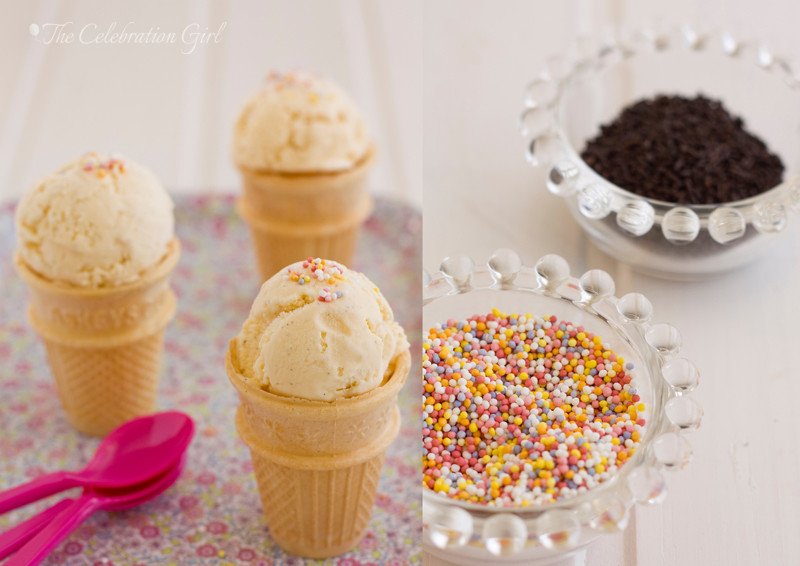
We enjoyed this Summer as Summers are meant to be enjoyed: fully. And now, as the last bits of ice cream disappear from our freezer, the weather slowly starts to get chillier and we start thinking about adding blankets to our beds, we are ready to fully embrace the colder days of Autumn.
I hope you all had a lovely Summer, or a cozy winter, depending on where you live, and I hope that you are all ready for the next season.
Have a wonderful week!
El otoño está aquí.
Septiembre casi llega a su fin y, aún cuando el verano aún se resiste a irse de Nicosia, algunos árboles ya han comenzado a perder sus hojas y, temprano por la mañana y al ponerse el sol, el aire ya está fresco y una adorable brisa señala el comienzo de la nueva estación.
Yo soy, en geneal, una persona otoñal. Me siento mejor en climas fríos, amo la nieve, y hasta la lluvia, y me cuesta terriblemente tolerar las altas temperaturas. Desde chica esperaba con ansias ver las primeras hojas amarillas aparecer en los árboles, el momento de sacar cardigans y sweaters de los baules y colocarlos en los placares (closets) y, sobre todo, ese saber que las manzanas y peras más deliciosas pronto llenarían los estantes de las fruterías. Pero este ano, algo cambió, y no fue mi amor por el frío, que sigue fuerte e intacto.
Este año,por primera vez, me entregué al verano, y lo aproveché sin desear que terminara.
Quizás haya sido porque hace siete años que vivo en climas cálidos (Costa de Marfil, primero, y ahora Chipre), quizás haya sido porque este fue el primer año que Luka y Zoe fueron a la escuela, entonces Agosto se transformó en sinónimo de vacaciones, y no tan sólo de otro mes caluroso. O quizás haya sido porque, como no salimos de viaje, aprovechamos al máximo la ciudad en que vivimos y exploramos la isla con nuevos ojos. O tal vez haya sido que, luego de una primera mitad del año complicada (2012 viene siendo un año duro), aprovechamos cada pequeña oportunidad para conectar, disfrutar de nuestra familia, y celebrar que estamos juntos.
Por el motivo que fuere, este verano que acaba de pasar decidimos desacelerar, desconectarnos de la parafernalia mediatica, mirar a nuestro alrededor y asegurarnos de estar presentes en nuestro aquí y ahora, de vivir concientemente, y disfrutar de aquello que tenemos, del lugar donde vivimos, y de todo lo que somos. Quisimos que este fuera un verano divertido, alegre, así que aprovechamos para poner en práctica todas las ideas que había estado recolectando en Pinterest desde hacía un tiempo.
Una de las cosas que queríamos era tener tanto contacto con la naturaleza como fuera posible, así que plantamos plantas aromáticas en el balcón y nos aseguramos de explorar distintos parques todos los días, y de hacer caminatas de observación de la naturaleza, todos los días, temprano por la mañana. Cuando el calor comenzaba a arreciar, volviamos a casa, disfrutabamos de la pileta plástica que colocamos en el balcón y, si se tornaba insoportable, entrábamos a casa a hacer arte y manualidades. Así pasamos las siestas jugando con plastilina y masilla, hicimos collages y móviles de papel que colgamos de la ventana para que la brisa de la tarde los hiciera volar y dar volteretas. Construimos autitos con tubos de papel higienico, llenamos la casa de globos por que sí, pegamos rayuelas en el piso y pasamos tardes enteras saltando en ellas. Creamos un cuadro de felpa y contamos historias y canciones con sus personajes.
Leimos mucho, libros viejos y nuevos, y llenamos el ipod de audio libros de nuestras historias favoritas y, con un poco de imaginación, dimos vida a nuestros libros. Hicimos barquitos de papel y los hicimos correr carreras con la fuerza de nuestros pulmones. Hicimos avioncitos de papel y pasamos tardes enteras haciendolos volar por toda la casa.¡ Y Zoe escribió su nombre por primera vez!
Durante los fines de semana, nos dedicamos a explorar la isla en viajecitos de un día. Visitamos el acuario de Protaras, donde vimos pulpos,tiburones, pinguinos, peces invertidos y pacus, entre otras especies. Fuimos al Zoológico de Limasol, donde vimos buhos, monos, pájaros diversos y hasta alces. Subimos a las montañas Troodos y almorzamos en un restaurant precioso, bajo las copas de los arboles, y delimitado por una corriente de agua fresca en la que se bañaban, contentos, patitos y gansos.
Pasamos un fin de semana en un hotel frente al mar, y fue maravilloso. Nos bañamos en la pileta (piscina), tomamos sol, jugamos y nos relajamos. Vimos atardeceres hermosos y amaneceres de ensueño, desde la calma de nuestro balcón y todo hizo que nos sintieramos tan tranquilos, relajados y felices como todos deberian poder sentirse en verano.
Celebramos el cumpleaños de Luka y Zoe con no una, no dos, sino tres tortas ¡cada uno!. Si, como lo leen: una mini torta de cupcakes el día de su cumple, una torta cada uno para la mini fiesta que hicimos en casa (fotos en el proximo post!) y una torta cada uno para llevar a la escuela, y así soplar las velitas con sus amigos y compañeros (estas son las tortas de la foto, que son muy simples y sencillas por fuera, pero con sorpresa adentro: son la famosa torta arco iris!)
No hicimos tortas ni cupcakes ni esas cosas que requieren horno porque hacía demasiado calor…pero hicimos muchos helados!
A comienzos de agosto compramos el accesorio helador de la KitchenAid y, a partir de entonces, comenzamos a experimentar y probar helados de distintos sabores. Busqué las recetas y la inspiración en blogs de confianza, y en internet, y la verdad es que no me decepcionaron. Hicimos dos helados de David Lebovitz, el de vaina de vainilla (INCREIBLE!) y el de chocolate (que tiene una textura de chocolate con leche), el helado de un banana de un solo ingrediente, the The Kitchn, y un helado vegano absolutamente delicioso, de chocolate y coco. Tambien probamos dos recetas de Food and Cook, el de palitos de chocolate y el de palitos de yogur y frambuesas. Mi recomendación: haganlos a todos! Y no se preocupen si no tienen máquina heladora, las recetas pueden adaptarse (si no saben cómo, dejenme un comentario en el post!)
La verdad es que disfrutamos de este verano como los veranos deben ser disfrutados: completamente. Y ahora que los últimos restos de helado comienzan a desaparecer de nuestro freezer, que el clima comienza, lentamente, a tornarse más fresco y que empezamos a pensar en agregar colchas a nuestras camas, ahora sí estamos listos para aprovechar cada minuto de los días fríos, del otoño.
Espero que ustedes hayan tenido también un verano hermoso, o un invierno cálido, dependiendo de dónde vivan, y espero que esten listos para vivir al máximo y disfrutar enormemente la nueva estación que apenas se asoma.
Que tengan una semana maravillosa!
by Marcela M. | Aug 10, 2012 | Blog, Parties, Uncategorized
Good Morning friends!
I hope you are having a lovely week, enjoying the warmth of summer (if you live in the Northern Hemisphere) or the cool days of winter (if you live in the South).
Luka and Zoe are currently on a break from nursery school and, for this reason, I have decided to take a break from blogging during this month, and to dedicate it completely to making this a summer to remember. A few weeks ago, I read THIS post on the blog Modern Parents Messy kids and it got me thinking about how time seems to fly, how childhood seems to go by in the blink of an eye.
I remembered, as I read, a passage from one of my favourite books, Ray Bradbury’s Dandelion Wine, where it says: “You’ll find out it’s little savors and little things that count more than big ones. A walk on a spring morning is better than an eighty-mile ride in a hopped-up car, you know why? Because it’s full of flavors, full of a lot of things growing. You’ve time to seek and find. I know, you’re after the broad effect now, I suppose that’s fit and proper. But you got to look at grapes as well as watermelons. You greatly admire skeletons and I like fingerprints; well, and good. Right now such things are bothersome to you, and I wonder if it isn’t because you never learned to use them. If you had your way you’d pass a law to abolish all the little jobs, the little things. But then you’d leave yourselves nothing to do between the big jobs and you’d have a devil of a time thinking up things? Cutting grass and pulling weeds can be a way of life.” So, I decided to make this a summer of little things: to blow lots of bubbles, to hunt for rocks, to explore new parks, to try new games, to bake more cookies, to laugh a lot, and jump on beds, and give “no”a little break. Without computer(except for talking to grandma (my mother) via skype), without cellphones, just trying our best to be present, to be mindful, to really be here and now.
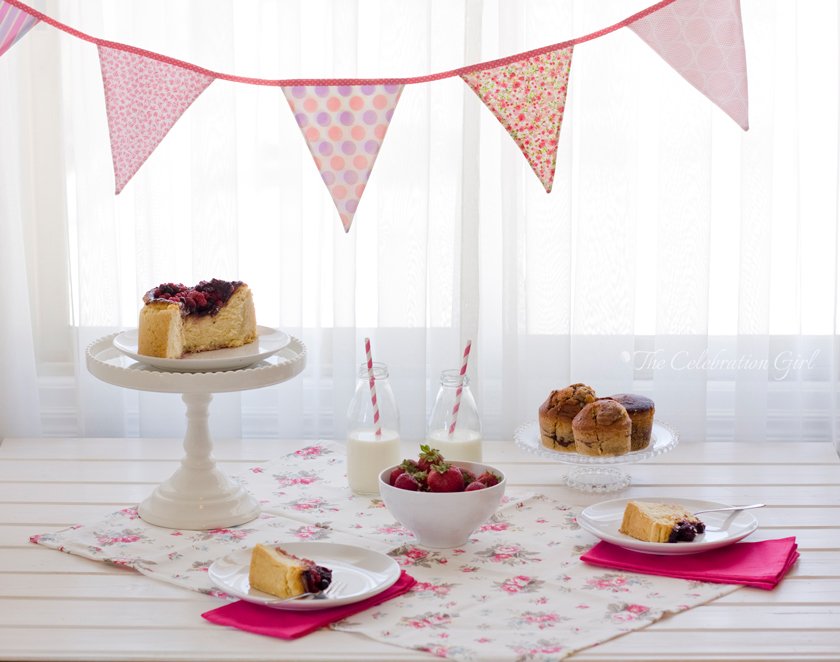
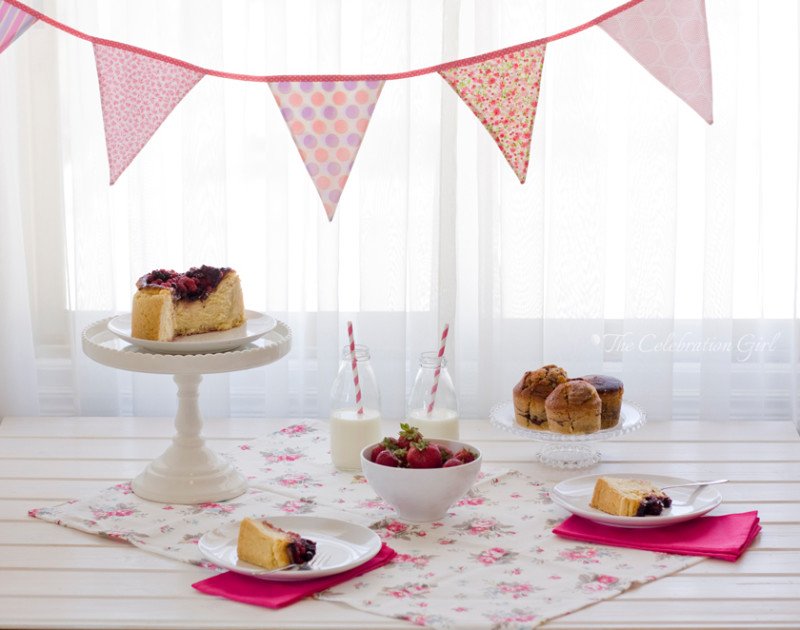
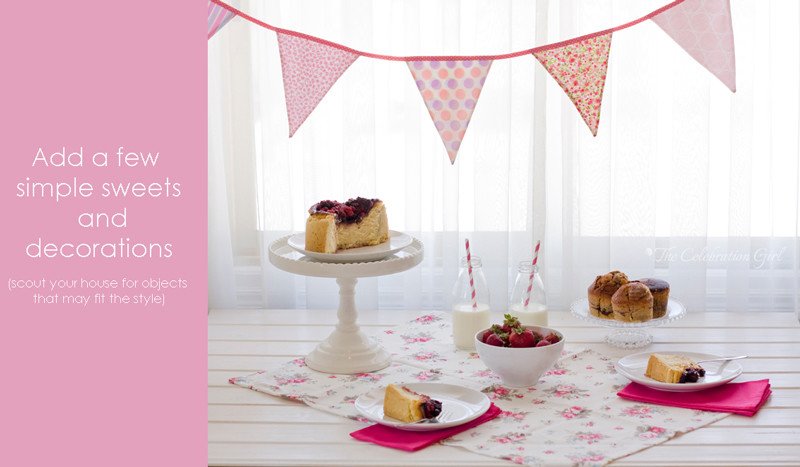
But I didn’t want to leave you just like that, so I put together a teeny tiny tutorial for planning a simple, yet pretty, table setting, which could be useful if you are entertaining but do not have a huge budget. This is how I do it:
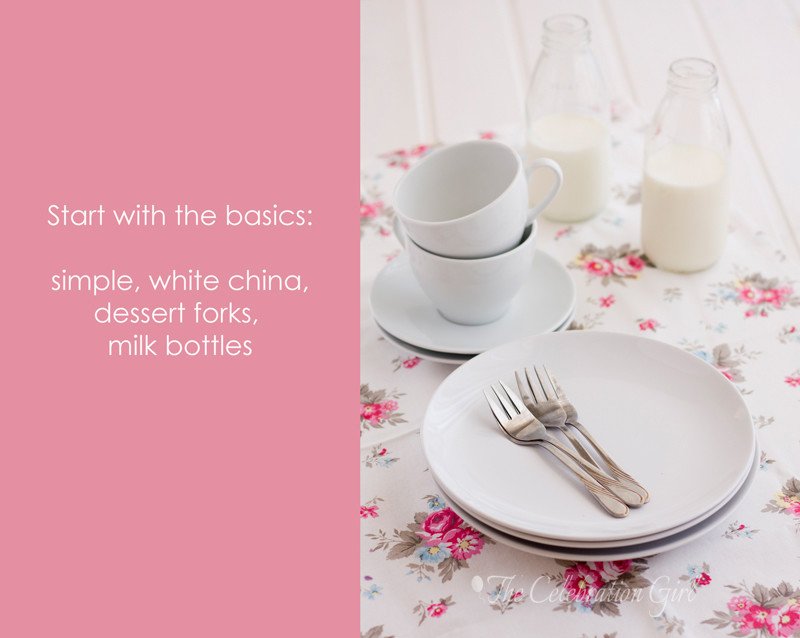
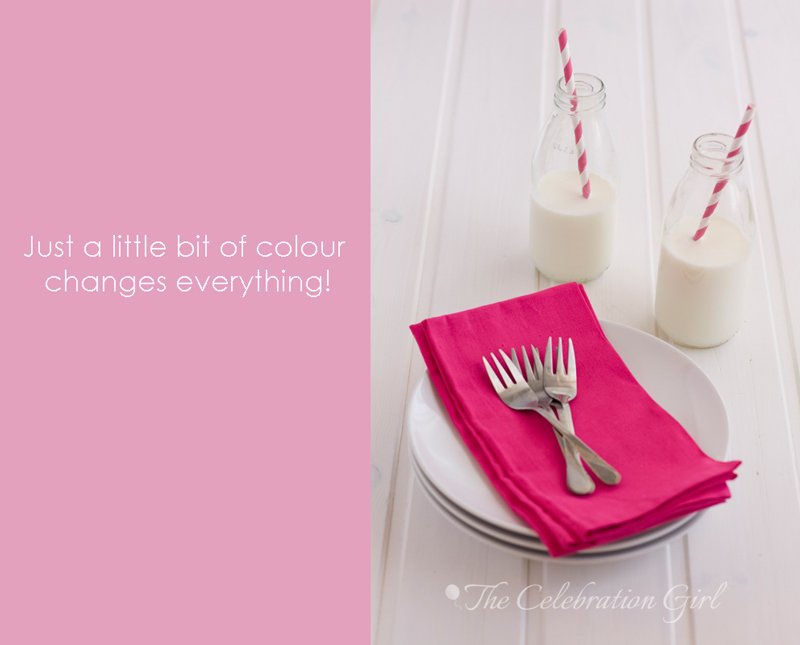
I don’t own expensive china, but I do own a set of very basic and versatile white plates and cups (from Ikea), which I can always pair with anything more colourful that I find around the house. I find that, when one doesn’t have tons of money and plenty of space for different tableware sets (I know I don’t!), white is the best choice. And one little secret: my milk bottles are not, in fact, milk bottles. They are recycled energy drink bottles! I scout supermarkets for cute bottles and sometimes chose products based on other uses I can give to the packaging.
If your china has a pattern or a different colour, don’t panic! Just keep reading!
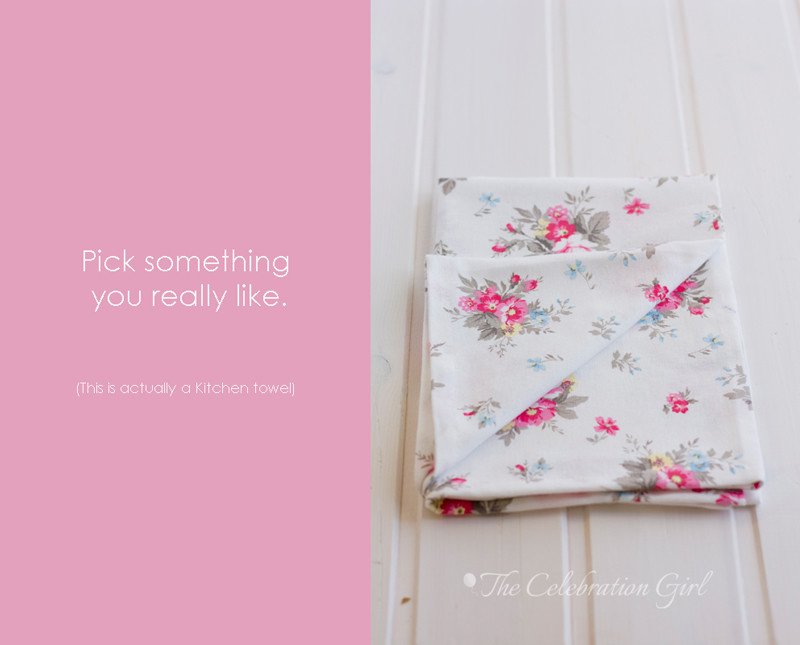
Next, pick something that you really like from your home. For my birthday I chose the above-pictured kitchen towel (which I don’t use as such because I find it too pretty!) and I used it as a place mat in the middle of the table, to add a pop of colour. But you could use anything: a vase, a wooden toy, a pretty box, anything that you find beautiful and that matches the look that you want for your table.
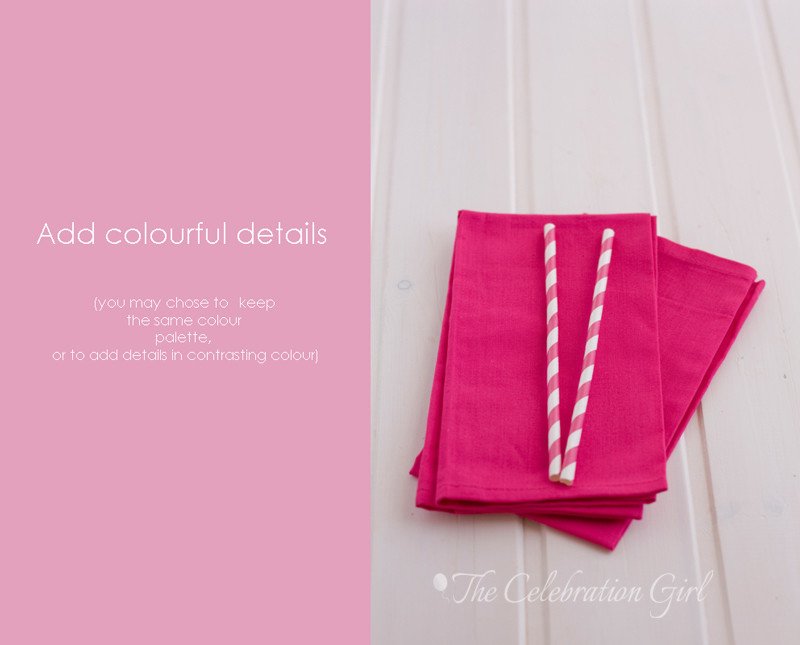
Colour is the next step…or you could chose to work with whites only, and then add interest by using different textures. But if you do chose colour, remember that you don’t need to stick to a monochromatic palette using only shades of the same colour, or colours that are next to each other on the colour wheel; you also have the option of working with contrasting colours. So, if your china has a blue pattern, you are not restricted to blues and greens, but you could also use oranges, yellows and browns and there are so many shades of each that the possibilities become endless!
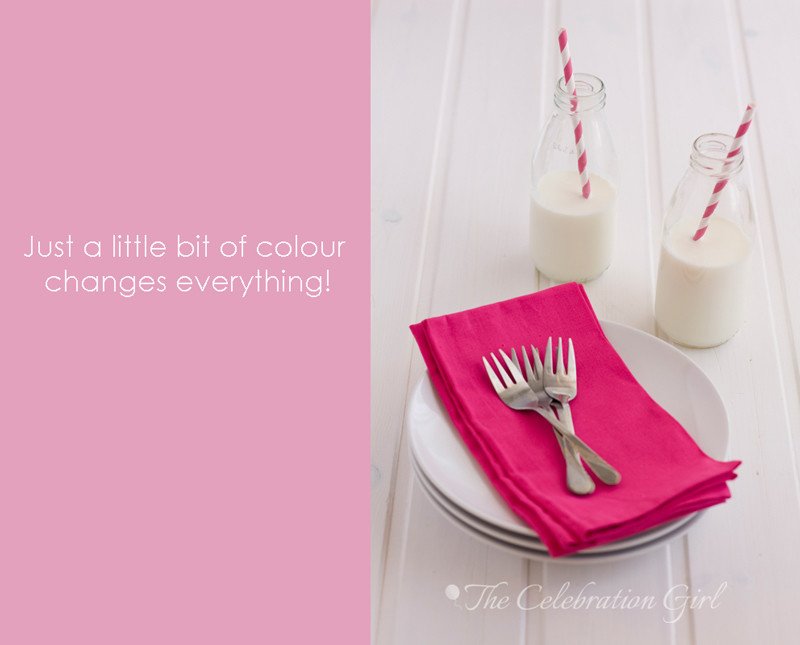
Work with what you already have, and remember that pops of colour don’t need to be expensive items: a few lemons, oranges, or even tomatoes, a couple of colourful straws, a few leaves or flowers from your garden (or the neighbour’s-ask first!), a few candles, a mason jar with some ribbon, anything can work. The banner from the picture above was taken from my daughter’s bedroom, for example, and the pretty glass cake stand? It’s not a cake stand at all, but a plate placed on top of an inverted bowl.
Finally, add food. Whatever food you like, it doesn’t have to be anything fancy. As much as I like beautifying food, I am a big believer that the most important thing is for it to taste delicious.
And most importantly, relax and have fun with those you love. That’s the only thing that matters.
Have a wonderful summer (or winter!)! See you again in September!
(Spanish translation coming soon)
by Marcela M. | Jul 21, 2012 | Blog, cookies, Recipe Box, Recipes, South America, Sweets, Travel, Uncategorized
Good evening dear friends! I hope you are having a lovely weekend.
Days have been incredibly HOT in Nicosia this past week, with temperatures ranging from 40 to 45.5 degrees celsius. Summer is definitely here and this means doing our best to minimize as much as possible the heat that comes into the house. This is why we clean early in the morning, and then try to keep all window shutters down, to turn the stove on as little as possible and, you guessed it, we avoid baking! We tend to opt for meals that require minimal cooking, such as fresh salads, and, for dessert, we eat fruits and simple home-made fruit lollies.
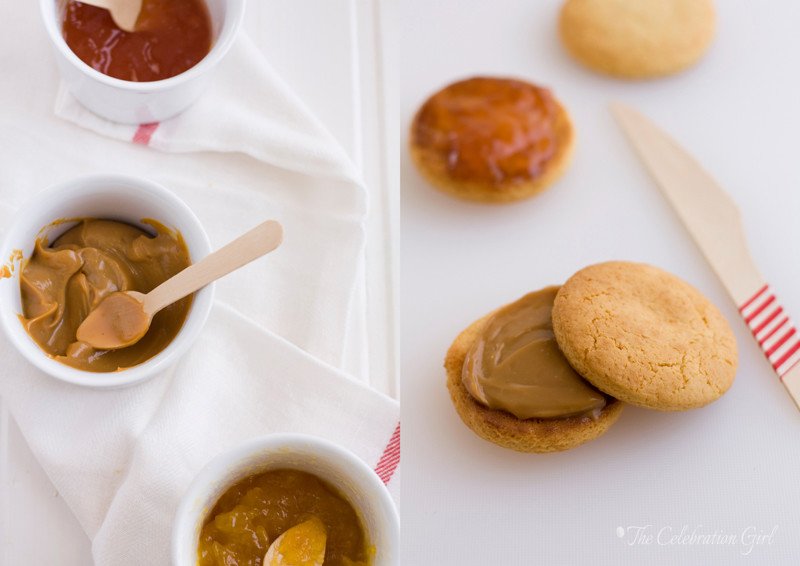
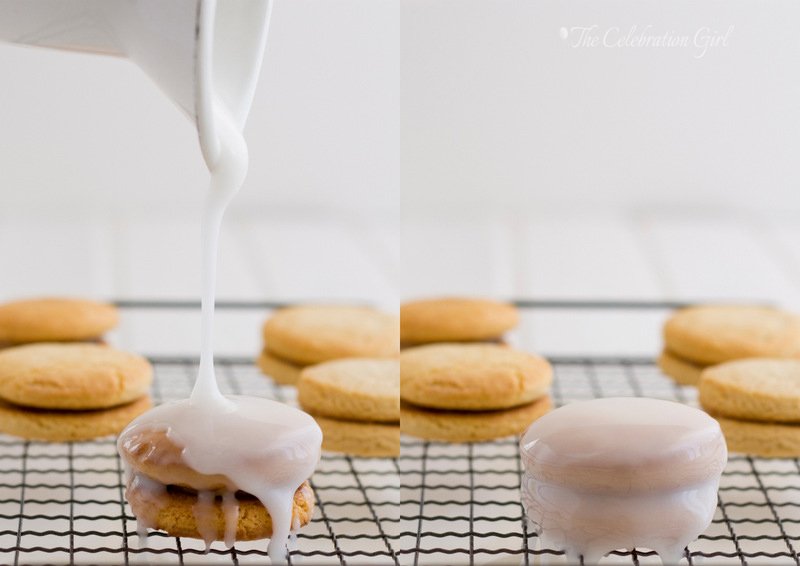
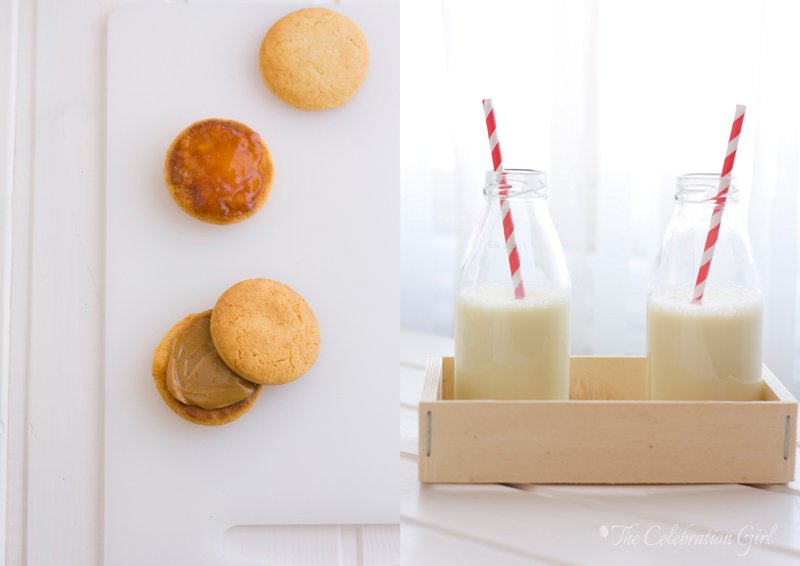
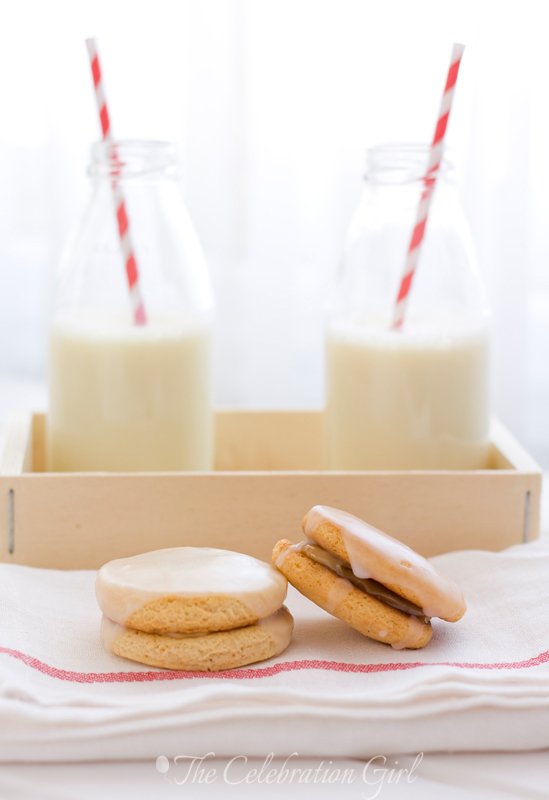
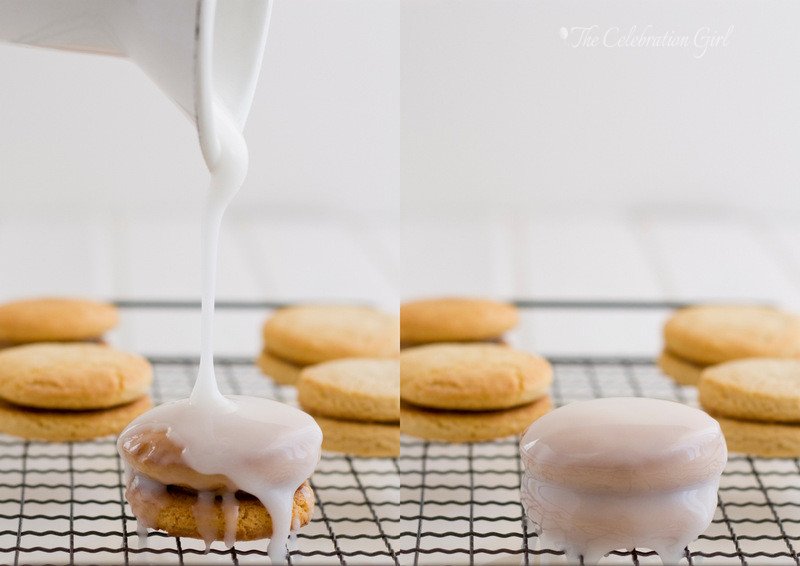
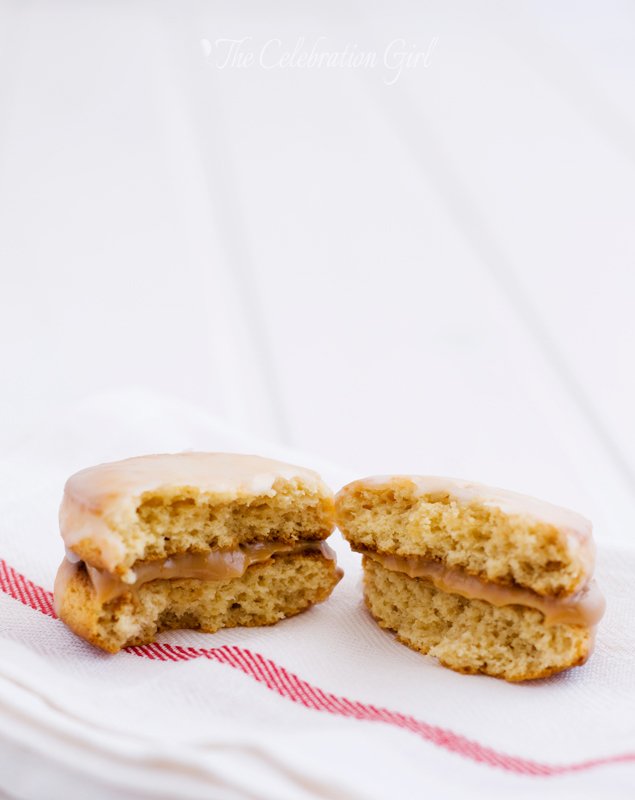
Sometimes, however, we do crave a little baked treat and, for those occasions, these alfajores are perfect: they are incredibly easy and they take only 5 to 7 minutes in the oven to be ready. After they have cooled down, they are sandwiched with fruit jam or dulce de leche and covered in the simplest glaze of all: icing sugar to which we just add a few tablespoons of boiling water and a sprinkle of lemon juice. They couldn’t be easier!
You may have noticed that I called these alfajores “semi cordobeses” , and there is a reason for that. I had been looking for a while for a recipe of the particular type of alfajores from my home city. I never had one because, when I lived there, I always bought them from a nearby store but, now that I live abroad and that I have children whom I would like to introduce to my culinary traditions, I wanted to be able to make them at home.
The search, however, proved to be difficult. It turns out that Argentina’s cocina criolla (créole cuisine) is famous for being “unreliable” or “moody”. Now, I honestly refuse to attribute human characteristics to any recipe and I believe, instead, that what happens is product of the typical way recipes are transmitted back home: as part of family heritage. Recipes are learned, first, by watching our elders prepare them at home and, later, by making them together with them when we are older. At my own home, for example, we rarely measured ingredients and recipes were rarely written down. We just knew how they were supposed to turn out and how to fix common problems, because we had been making them our whole life.
This reminds me of an anecdote from my grandmother. One day, back in 1997, I was about to leave Argentina for a few months when I realized that I had never written down some of her delicious staple recipes and that I would not necessarily remember how they were done because they were not everyday dishes. So I sat down with her, in her kitchen, armed with a notebook and a mate, and she started trying to explain to me how the recipes were done. Our dialogues went more or less like this:
Me: So, let’s see, “rosquitas“. What ingredients do they take?
Grandma Antonia: 6 eggs, 3 tablespoons of alcohol, 1/2 kilo of flour.
Me: And how do I make them?
Grandma Antonia: Just mix everything until you get a smooth dough. But if you feel that it turns out to be too dry, add another egg.
Me: (confused) But how do I know if the dough is too dry and I should add another egg or if I should just keep mixing??
Grandma Antonia: I don’t know! I just know!
Of course, we ended up making rosquitas together and I took many more notes than the ones initially provided by my grandmother. She knew so well how to make the recipe that it was hard for her to put herself in my shoes, or in the shoes of anyone who, well, just didn’t know everything that she did.
Most of the recipes I have from my home are like that. They mention “a drop of milk”, “a bit of flour”, or they get started with 100 grs of chocolate but then add unmeasured extra quantities of it as the preparation progresses, according to how we know the dish is supposed to turn out because we made it countless times before. This is perfectly okay when recipes are transmitted within families but it becomes a problem when one has never seen the dish being prepared before. People tend to transmit the initial ingredients and the basic procedures but, more often than not, they simply forget to pass down vital information that one only acquires when making the food with them. Then, of course, fiascos become very common!
Let me just tell you that I had many of those fiascos before achieving this recipe (which gave me a few headaches too!) and I still haven’t found a good one for our traditional colaciones. What’s more, I don’t think my search for the real alfajor cordobés is over yet. These are delicious cookies, the texture of which does resemble that of our traditional sweets…but the taste is not quite “it”, in my opinion, and that is the reason I called them “semi-cordobeses”. That being said, do try them, because they are really, really tasty!
Here is the recipe:
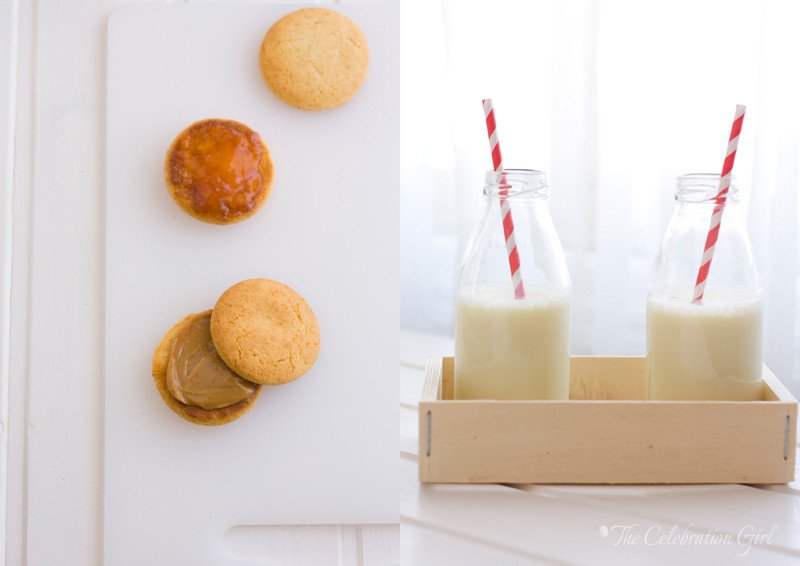
Ingredients (For 25 alfajores of 4 cms diameter/ 50 single cookies)
– 500 grs all purpose flour (0000)
– 10 grs amonium bicarbonate (or 12 grs sodium bicarbonate, which is less smelly)
-10 grs baking powder
– 120 grs soft butter or margarine
– 2 eggs (I used M)
– 200 grs sugar
– 50 grs honey
– 15 grs malt extract (I used barley malt extract, which I found in the organic food section of my local supermarket)
– Fruit jam of your choice or dulce de leche, for sandwiching the cookies. I used quince jam, apricot jam and dulce de leche, for more variety. Traditional jams are quince, apricot, apple and pear.
– 4 cups of icing sugar
– 1 tablespoon of lemon juice
– 3/4 cup of boiling water (or 12 tablespoons)
Preparation:
1) Mix flour, baking powder and bicabonate.
2) Pour flour mix on the kitchen counter and make a hole in the middle
3) Add butter, eggs, honey, malt extract and sugar in the hole. Start mixing the wet ingredients with your hands, and once this is done, start incorporating the flour, little by little, until you get a uniform dough.
4) Cover the dough in plastic wrap and put in the refrigerator for 20 minutes.
5) In the meantime, prepare your baking sheets by lining them with baking paper.
6) A few minutes before removing the dough from the refrigerator, preheat the oven to 250 degrees C (maximum)
7) Roll the dough 1/2 cm wide and cut circles using a cookie cutter. Place the circles on baking sheets and put them in the freezer for 5 minutes. NOTE: The cookies grow in the oven, so place them apart on the baking sheet or they will join one another. Also, do not skip the freezer part or they will lose their shape!
8) Bake in a hot oven for 5 to 7 minutes, until they barely begin to brown. Be careful, they brown easily!
9) Remove from the oven, transfer to a wire rack and let cool completely
10) Add one tablespoon of jam or dulce de leche to one cookie, and sandwich it by placing another one on top. Now you have an alfajor! Continue until all cookies have been sandwiched together.
11) Prepare the glaze by adding the boiling water and lemon juice to the icing sugar and mixing well, until no lumps remain.
12) Place the alfajores on a wire rack and pour the glaze over them. Let the glaze cool and harden, and eat.
You may store them in the freezer for up to 3 months. I hope you will like them!
Buenas noches queridos amigos! Espero que esten pasando un hermoso fin de semana!La semana pasada tuvimos unos días increíblemente calurosos en Nicosia, con temperaturas que iban de los 40 and los 45.5 grados centígrados. El verano se ha instalado aquí definitivamente y eso significa, para nosotros, hacer todos los esfuerzos posibles por minimizar la entrada de calor a la casa. Por este motivo, limpiamos bien temprano a la mañana y luego intentamos mantener todas las persianas bajas, cocinar lo menos posible y, se imaginarán, evitamos prender el horno! Así que optamos por comidas livianas, que requieran mínima cocción, como ensaladas frescas, muchas frutas y helados palito de fruta, bien simples.A veces, sin embargo, nos agarren esos ataques de algo dulce-dulce y, para estos casos, estos alfajores son perfectos: son increiblemente fáciles de hacer y sólo requieren 5 a 7 minutos de horno. Una vez que estan cocidos y ya se han enfriado, se los une con mermelada de frutas o dulce de leche y se los cubre con el baño más sencillo que existe: azucar impalpable a la que se le agrega agua hirviendo y un poquito de limón. No pueden ser más sencillos!Seguramente habrán notado que llamé a estos alfajores
semi cordobeses y esto tiene una razón de ser. Hace ya bastante venía buscando una buena receta de los alfajores tradicionales de mi terruño (
de los que hablé en este post). Cuando vivía en Argentina nunca los hice porque, en caso de antojo, no tenia más que ir al kiosco a comprar uno, pero ahora que vivo en el exterior y que quiero transmitirle a mis hijos mis tradiciones culinarias, comencé a querer poder hacerlos en casa.
La búsqueda, sin embargo, no fue sencilla. Descubrí, entre otras cosas, que la cocina criolla tiene fama de “poco confiable” “traicionera” o “temperamental”. Ahora bien, honestamente me niego rotundamente a asignarle a una comida caracteristicas humanas y creo que lo que en realidad ocurre, que el motivo por el que las recetas “no siempre salen bien”es otro, y está ligado a la forma en que se transmiten las recetas: como parte del acervo familiar de cada uno. Las recetas no se escriben, se aprenden mirando a nuestros mayores, cuando somos chicos, y haciéndolas con ellos, cuando crecemos. En mi casa, por ejemplo, rara vez mediamos ingredientes meticulosamente, ni escribiamos instrucciones detalladas. Simplemente
sabíamos cómo debía quedar el plato y cómo solucionar posibles problemas, porque lo veníamos haciendo toda nuestra vida.
Escribo estas líneas y recuerdo una anecdota, muy ilustrativa, que involucra a mi abuela. Un día, allá por el año 1997, días antes de que yo fuera a partir de Argentina por unos meses, caí en la cuenta de que nunca había anotado algunas de aquellas deliciosas recetas que mi abuela no hacía tan frecuentemente y que, por lo tanto, yo no conocía de memoria. Así que me senté con ella en la cocina de su casa, con un cuadernito que aún conservo, y una pava de mate, a intentar que ella me explicara su recetario personal. Nuestros dialogos terminaron siendo algo más o menos asi:
Yo: Bueno, a ver, rosquitas. ¿Qué ingredientes llevan?
Abuela Antonia: 6 huevos, 3 cucharadas de alcohol, 1/2 kilo de harina
Yo: Y como las hago?
Abuela Antonia: Mezclá todo hasta que te quede una masa suave. Pero si ves que la masa está muy seca, agregá un huevo
Yo: (confundida)…pero cómo sé si la masa está seca como para agregarle un huevo o si sólo tengo que seguir trabajandola
Abuela Antonia: ah, no sé! Yo sólo sé!
Obviamente terminamos haciendo las rosquitas juntas y en ese momento tomé muchisimas más notas para complementar las instrucciones iniciales dadas por mi abuela. Ella conocía tan bien cómo hacer la receta que le resultaba dificil ponerse en mi lugar, o sea, en el lugar de una persona que no supiera aquello que ella sabía tan a la perfección.
La mayoría de las recetas que traigo de casa son así. Hablan de “un chorrito de leche”, “un poquito de harina” o mencionan 100 grs de chocolate, pero no cuentan todos esos “poquitos extra” que se van agregando durante la preparación, conforme cómo el plato “debe quedar”. Esto funciona de maravillas con las recetas familiares, porque uno las conoce de memoria y no necesita una receta detallada, pero se transforma en un problema para alguien que nunca hizo el plato antes. La gente tiende a transmitir sólo los ingredientes iniciales y los procedimientos básicos, olvidando transmitir tambien, la mayor parte de las veces, aquellos datos extra que son vitales para obtener un buen resultado. Y en esos casos, claro, los fiascos son momumentales y uno se queda mirando el horroroso resultado final y preguntándose qué habrá ocurrido.
Dejenme decirles que, en la busqueda de esta receta he tenido muchos de esos fiascos, que, aun esta receta misma me dio varios dolores de cabeza al comienzo, hasta que logré “rellenar los espacios vacíos”, y que aún no logro dar con una buena receta de colaciones. Y más aún, todavía no considero que mi búsqueda del perfecto alfajor cordobés haya culminado. Estos alfajorcitos son deliciosos, y tienen una textura muy similar…pero el gusto no es exactamente el del alfajor cordobés tradicional, en mi opinión, y es por este preciso motivo que los llamé “semi-cordobeses”. Dicho esto tambien les digo que no dejen de probarlos porque son realmente muy, muy ricos!
Aquí está la receta:
Ingredientes
– 500 grs de harina cuatro ceros
– 10 grs de bicarbonato de amonio o 12 grs de bicarbonato sódico ( que es menos oloroso)
– 10 grs de polvo de hornear
– 120 grs de margarina o manteca
– 2 huevos
– 200 grs de azucar
– 50 grs de miel
– 15 grs de extracto de malta
– mermelada de frutas o dulce de leche para unir las tapitas. Yo usé mermelada de membrillo, de damascos y dulce de leche. Las mermeladas tradicionales son membrillo, damascos, pera y manzana.
– 4 tazas de azucar impalplable
– 3/4 taza de agua hirviendo
– 1 cucharada de jugo de limón
Preparación:
1) Mezcle la harina con el polvo de hornear y el bicarbonato
2) Coloque la harina sobre la mesada en forma de corona (haciendo un huevo en el medio)
3) Agregue, en el hueco mencionado, la manteca o margarina, los huevos, el azucar, la miel, y el extracto de malta. Mezcle los ingredientes húmedos con las manos y, una vez incorporados, comience a agregar de a poco el harina, moviendola hacia el centro en pequeñas cantidades, hasta formar una masa uniforme.
4) Cubra el bollo de masa con papel film y lleve a la heladera por 20 minutos.
5) Mientras tanto, prepare las placas para horno recubriendolas con papel de hornear (antiadherente).
6)Unos minutos antes de sacar la masa de la heladera, precaliente el horno a maximo/250C
7) Saque la masa de la heladera y estirela con palote de amasar hasta que tenga un ancho de 1/2 cm. Corte circulos de aproximadamente 4 cms de diametro, coloquelos sobre la placa y lleve la placa al freezer por 5 minutos. NOTA: las tapitas crecen en el horno, asi que coloquelas suficientemente separadas la una de la otra o se unirán al cocerlas. Asimismo, no omita ponerlas en el freezer o perderan la forma!
8) Cocine las tapitas en horno fuerte por 5 a 7 minutos, hasta que esten apenas doradas. Tenga cuidado, se doran muy rápido, vigílelas!
9)Retire del horno, transfiera a una rejilla, y deje enfriar totalmente.
10) Una vez que las tapitas estén frias, unte la mitad con una cucharada de la mermelada/dulce de su elección, y cierrelas con las tapitas restantes, haciendo un sandwich. Una vez haga esto, usted tendrá en sus manos alfajores!
11) Prepare el baño de azucar agregando el agua hirviendo y el limon al azucar impalpable y revolviendo bien hasta que no queden grumos.
12) Coloque los alfajores sobre una rejilla y cubralos con el baño de azucar. Deje que el baño se seque y endurezca y disfrute!
Pueden guardarlos en el freezer por 3 meses. Espero que les gusten!

Have a wonderful weekend and a great start of the new week!
by Marcela M. | Jul 4, 2012 | Blog, Europe, Main courses, Recipe Box, Recipes, Salads and dips, Savories, Travel, Uncategorized
Good afternoon dear friends!
I hope you are having a lovely week! I hadn’t planned to take time off blogging but life took over my plans, and I had to attend to more urgent matters, which is why these recipes are being published late.I had originally planned to bring them to you on Monday the 18th of June (which was the official publication day for savory recipes at Circulo Whole Kitchen) but, as mentioned above, it was not possible. I didn’t want to miss the opportunity of publishing them, however because June’s proposal is very special to me, and because all flavours are summery and ideal for barbecues and outdoor entertaining.
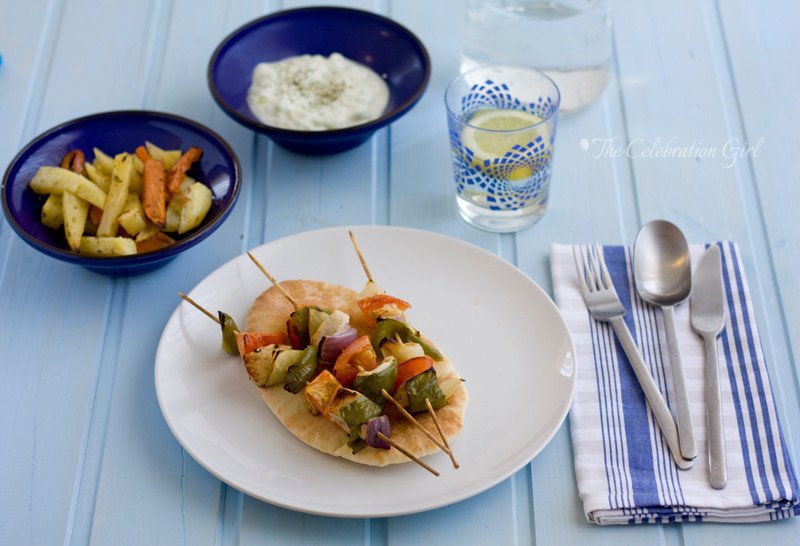
During the month of June, Circulo Whole Kitchen’s savory proposal included three recipes which constitute a traditional Greek meal…and since I live in Greek Cyprus, they are a big part of my life and of my memories of this place . I have already shared one of these recipes with you, that of Tzaziki salad, and for the rest of the menu (which even included freshly baked pitta bread!), I used flavour combinations and marinades that I learnt here. It is my way of bringing you a part of my newly adopted culture, and my children’s first one.
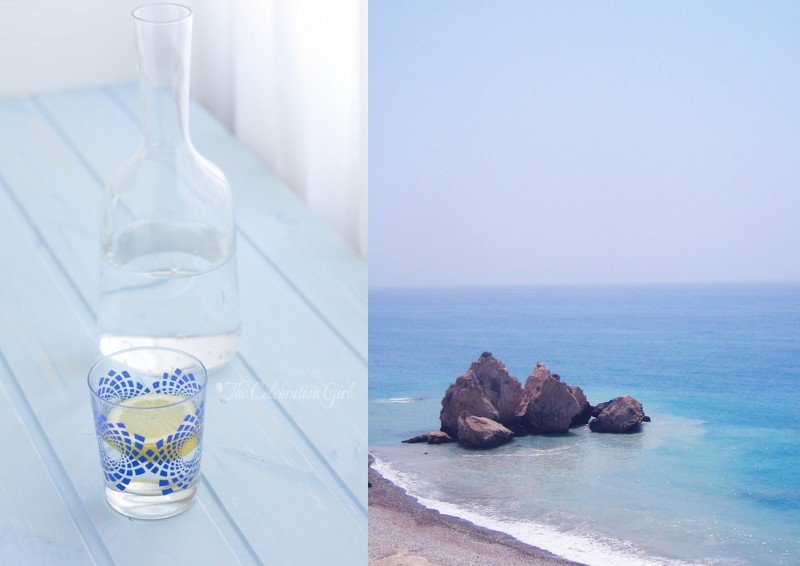
The first time I came to Cyprus was in August 2007, to visit my husband. At the time, I was still working in Ivory Coast (where we had met), and he had arrived to Nicosia a month before. I was meant to join him by the end of the year but we didn’t want to spend 6 months apart, so I took 10 days of vacations and came to see him during the summer. During weekdays, when he was at work, I would stroll the empty streets (Nicosia is a ghost city in August) and, on weekends, we would travel around the island, to get to know our new home. We visited Paphos, Limassol, Larnaca, Aphrodite’s birth place, Kakopetria and other places in between and we were captivated by the calm, quiet, leisure-like mood of the island.
An important part of exploring a new place is, of course, tasting its food, and some of the foods we tasted were the ones that are the object of this post. Now, I had tasted souvlaki before, of course. We call them brochettes in Argentina, using the french word, and I had also had them as kebabs in Ivory Coast (called after their arabic denomination, which means “roast meat”) but the difference lied in the sauces used for marinating them. Until then, I was used to simply brushing meat and vegetables in olive oil and adding rosemary or thyme, or just lemon, and here were marinades that involved wine, cinnamon, yogurt, and french fries served with oregano. I was fascinated and remember scribbling the ingredients mentioned in the menu in paper napkins to try to emulate the recipes at home.
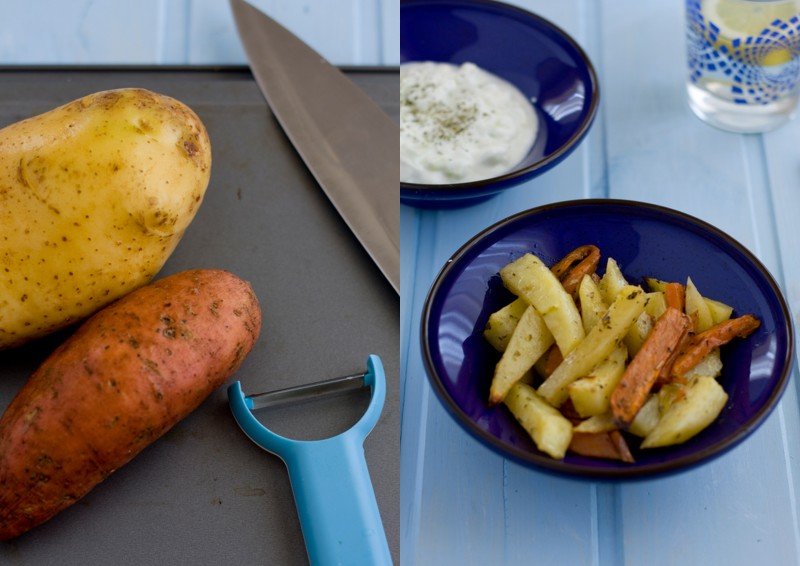
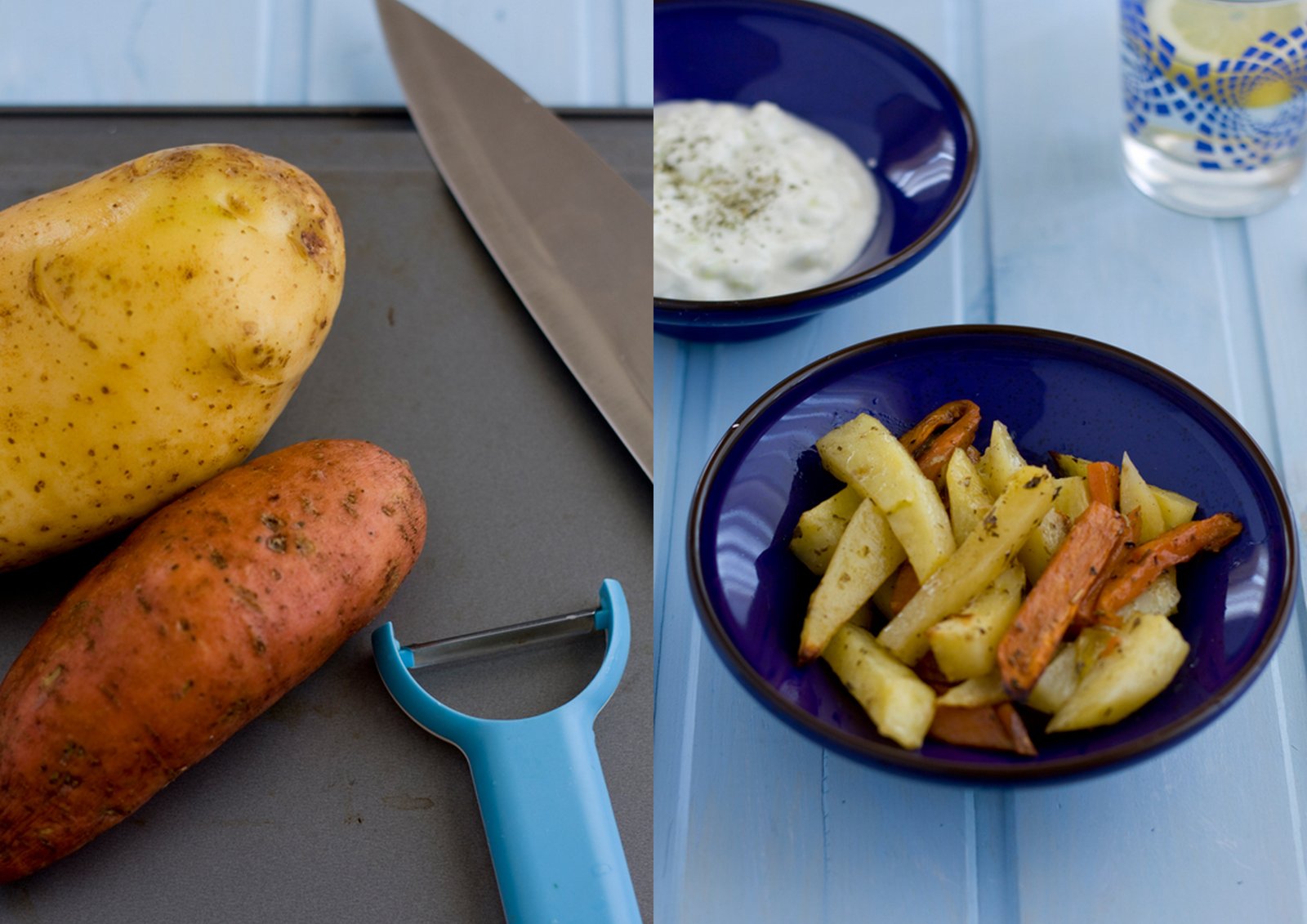
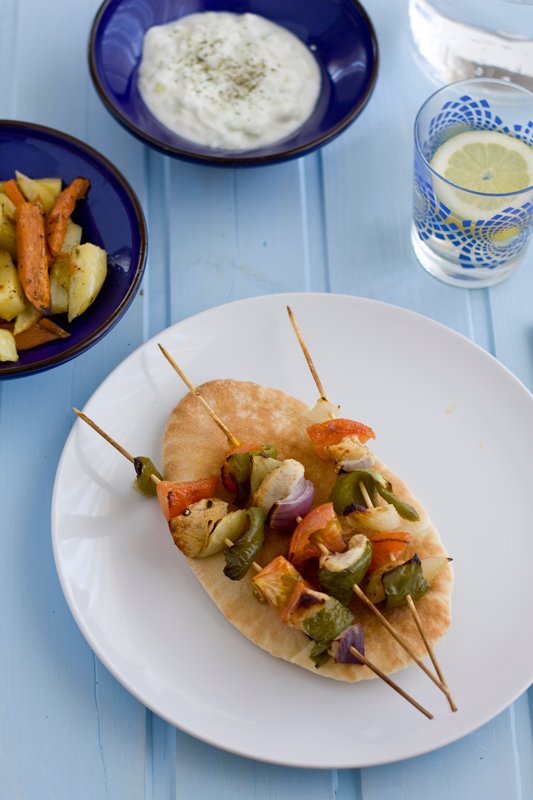
It is through experimenting with the recipes and comments generously provided to me by the people that came into my life since I arrived to Cyprus that I ended up with the chicken marinade for this souvlaki. I accompanied them with traditional tzatziki (using the recipe that my sister in law shared with me many years ago), and with oven- roast mixed potatoes, brushed in olive oil and sprinkled with oregano. For the pitta bread, I used the recipe provided by Circulo Whole Kitchen.
Here are the recipes:
Souvlaki:
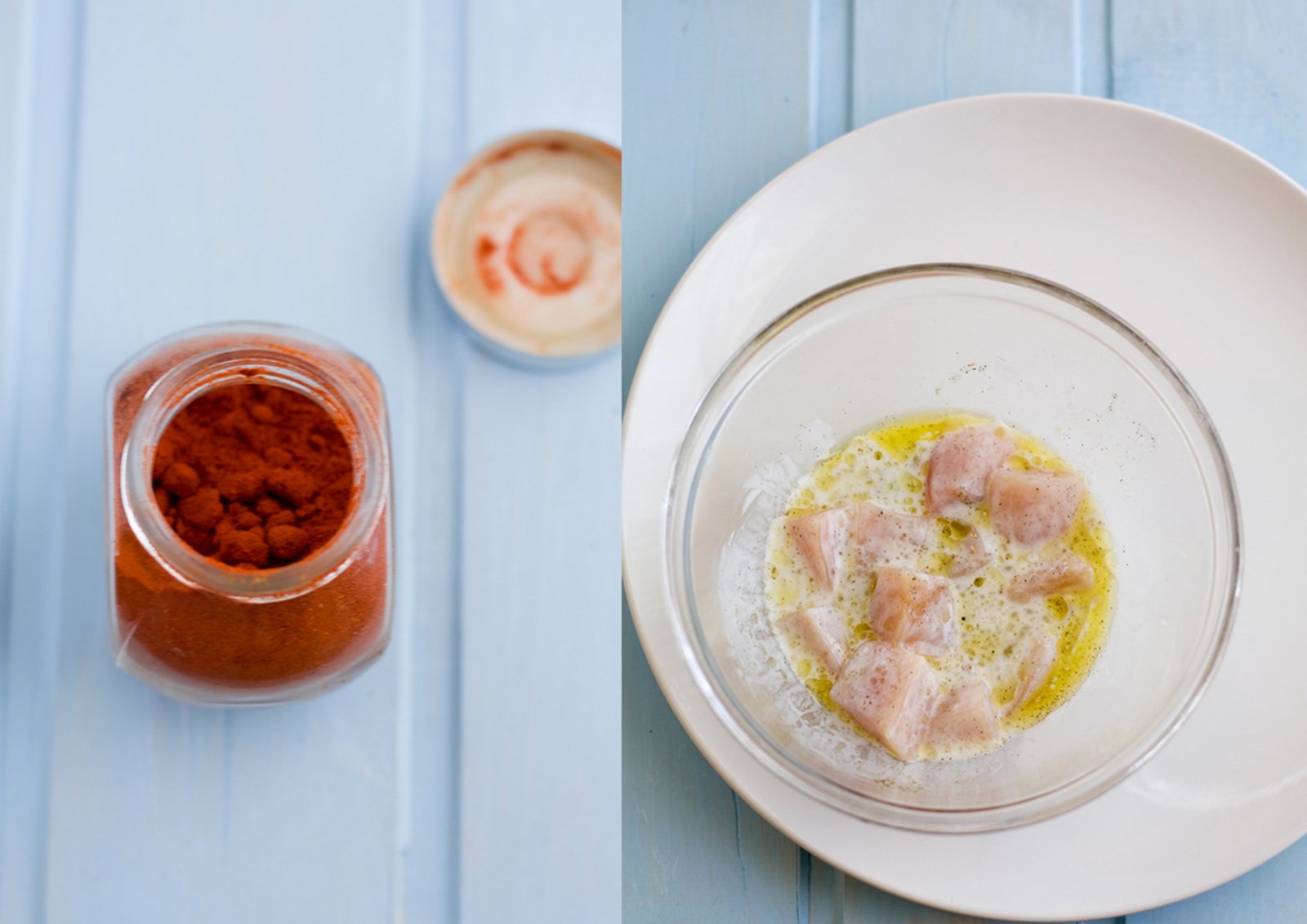
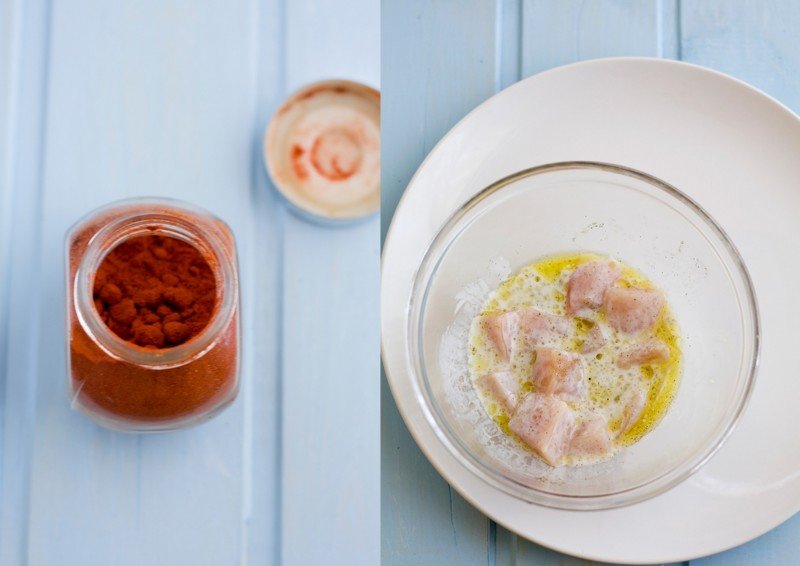
Ingredients (for 8 sticks): 3 tablespoons greek yogurt, 3 tablespoons olive oil, 1 clove of garlic, crushed, 2 teaspoons paprika, salt and pepper to taste, 1 big chicken breast, 1/2 green pepper, 1 tomato, 1/2 red onion, 1/2 white onion, .
Preparation:
1) Mix yogurt, olive oil, garlic, paprika, salt and pepper in a bowl. Dice the chicken breast and add the pieces to the yogurt marinade. Cover with cling film and leave in the refrigerator a minimum of 5 hours (preferably overnight).
2) Dice the vegetables and set aside. Remove the marinating chicken from the refrigerator and start assembling the souvlaki, mixing meat and vegetables. Place them side by side on a baking dish brushed with olive oil and pour any remaining marinade over them.
3) Grill or cook in the oven until ready.
Pitta bread:
Ingredients: 500 grs all purpose flour, 2 teaspoons salt, 2 tablespoons olive oil, 240 ml warm milk, 240 ml warm water, 25 grs fresh yeast.
Preparation:
1) Mix flour and salt. Set aside.
2) Mix milk and water and pour over the yeast, mixing until dissolved
3) Add the the liquid mix to the flour and incorporate. Work the dough thoroughly, until really smooth and soft (this is important! do not skip this step!)
4) Form a ball of dough, place in bowl, cover with cling film and let it rest until it doubles its volume.
5) Flour the counter, put the dough on it, and pat it against the counter a couple of times, in order to remove air.
6) Cut the dough in small portions, cover with a kitchen towel and let them rest for about 15 minutes, in a warm place.
7) Once the small portions of dough have risen, roll them to give them a circular shape, until they are 1/2 cm thick. Place them in baking sheets, cover them and let them rise again.
8) Once risen, cook in a hot oven (220C) for about 6-10 minutes. They should not brown, only be crispy on the outside. Store them one on top of the other, covered with a kitchen towel for maximum freshness.
Oven-roast mixed potatoes:
Ingredients: 1 big potato and 1 big sweet potato, olive oil, oregano
Preparation:
1) Peel and cut the potatoes alongside (as if you were making French fries)
2) Place them on a roasting pan, and brush them with olive oil.
3) Mix salt with one tablespoon of oregano and sprinkle over the potatoes. Cook in the oven until just tender.
Tzaziki (originally published in this post)
Ingredients: 1 cucumber, 1 clove of garlic, greek yogurt and a little bit of parsley for garnishing.
Preparation:
1)Cut the cucumber into thin slices, and then chop them finely. Place them in a bowl.
2)Chop a clove of garlic (or half, if you are not a very garlicky person) and add it to the cucumber.
3) Add greek yogurt (500 ml) and mix well.
4) Chop a few parsley leaves to garnish.
Con sabor latino...
Buenas tardes queridos amigos!
Espero que esten pasando una hermosa semana! No había planeado tomarme vacaciones del blog y tardar tanto en publicar pero la vida se interpuso en mis planes y tuve que ocuparme de asuntos más urgentes, motivo por el cual estas recetas se publican recien hoy. Mi idea original era publicar este post el 18 de junio (ups!), que era el día oficial de publicación de las recetas del Circulo Whole Kitchen, pero, como mencioné anteriormente, lamentablemente ésto no fue posible. Elijo publicarlas, sin embargo, aún cuando haya pasado tanto tiempo, porque la propuesta del Circulo Whole Kitchen para el mes de junio tiene una importancia especial para mí, y porque todos los sabores incluidos son muy veraniegos, ideales para asados y reuniones al aire libre.
En el mes de junio,el Circulo Whole Kitchen nos invitó a preparar tres recetas tradicionales griegas…y como yo vivo en la parte griega de Chipre, estas recetas forman parte de mi vida diaria, y estos sabores forman parte de los recuerdos de esta tierra adoptiva que llevaré conmigo a donde vaya. Una de estas recetas (la de tzaziki), ya la compartí con ustedes en ESTE POST, pero la repito aquí para que no tengan que andar buscando en los archivos (aunque buscar en fácil ahora, no? 😉 Para el resto del menú, utilicé combinaciones de sabores y marinadas que aprendí aquí. Esta es mi forma de acercarles una partecita de mi cultura de adopción- y la primera de mis hijos.
La primera vez que vine a Chipre fue en agosto de 2007, para visitar a mi marido. En ese tiempo yo aún estaba trabajando en Costa de Marfil (donde nos habíamos conocido) y él había llegado a Nicosia un mes antes. Ya habíamos decidido que yo me le uniría aquí definitivamente a fines de ese año, pero 6 meses nos parecía demasiado tiempo para estar separados, así que yo vine a visitarlo durante 10 días en el verano para acortar el tiempo a la distancia. En esas vacaciones comenzamos a conocer la isla. Los días de semana, mientras él trabajaba, yo paseaba por las calles desoladas de Nicosia (que es una ciudad fantasma en agosto!) y, los fines de semana, explorábamos el que sería nuestro nuevo hogar. Así visitamos Pafos, Larnaca, Limassol, la roca donde nació Afrodita, Kakopetria y otros lugarcitos, y quedamos cautivados por el animo veraniego, calmado, tranquilo de la isla.
Una parte importante de explorar un lugar desconocido es, claro está, probar sabores nuevos, y algunos de esos sabores nuevos para mí son los que incluyo en este post. No, no es que haya probado souvlakis por primera vez en este viaje, de hecho en Argentina los llamamos brochettes (usando la palabra francesa) y tambien los había comido en Costa de Marfil (donde los llaman kebabs, usando la palabra árabe, que significa “carne asada”), pero la diferencia estaba en los condimentos utilizados y en la forma de emplearlos. Antes de venir a Chipre, cuando yo hacía brochettes no marinaba la carne, sólo la pincelaba en aceite de oliva y espolvoreaba romero o tomillo o, simplemente, limón…y de pronto aquí me encontraba con marinadas que utilizaban vino, canela, yogurt, paprika y las papas fritas se servian espolvoradas con oregano. Estaba fascinada con los nuevos descubrimientos culinarios, y anotaba los ingredientes que leía en los menus en servilletas de papel para hacer pruebas en casa, e intentar emular las recetas.
La marinada que usé en estos souvlaki de pollo fue producto, justamente, de esos experimentos nacidos de los comentarios generosos y de las recetas que me brindaron personas que aquí conocí. Los serví sobre pan de pitta casero y los acompañé con la tradicional tzaziki (hecha con la receta de mi cuñada) y con papas y batatas rostizadas al horno, pinceladas en aceite de oliva y espolvoreadas con sal oreganada. Espero que les gusten!
Aqui estan las recetas:
Souvlaki:
Ingredientes (para 8 palitos) : 3 cucharadas de yogurt griego, 3 cucharadas de aceite de oliva, 2 diente de ajo machucado, 2 cucharadas de te de paprika, sal y pimienta a gusto, 1 pechuga de pollo grande, 1/2 pimiento morrón verde, 1 tomate, 1/2 cebolla colorada, 1/2 cebolla blanca
Preparacion:
1) Mezclar en un bowl yogurt, aceite, ajo y paprika. Cortar el pollo en cubos y agregar a la marinada de yogurt. Cubrir con papel film y dejar reposar en la heladera un mínimo de 5 horas (preferentemente toda la noche)
2) Una vez transcurrido el tiempo indicado, cortar los vegetales en cubos y retirar el pollo de la heladera. Armar los souvlaki cuidando de intercalar distintas verduras con la carne. Una vez armados, colocarlos en una placa para horno pincelada con aceite de oliva y verter encima todo restante de marinada.Llevar a horno mpderado a fuerte hasta que estén cocidos.
Pan de pitta (receta de Circulo Whole Kitchen)
Ingredientes: 500 gr de harina, 2 cucharaditas de sal, 2 cucharadas de aceite de oliva, 240 ml. de leche tibia, 240 ml. taza de agua tibia, 25 gramos de levadura fresca
Preparación:
1) Poner en un bol la harina junto con la sal.
2) Mezclar la leche con el agua e incorporarla a la levadura mezclando hasta disolverla. Agregar esta mezcla a la harina, poco a poco, junto con el aceite de oliva e ir mezclando hasta que esté todo el líquido incorporado.
3) Formar una masa y comenzar a trabajarla en forma continua hasta que esté bien lisa y suave. Es importante que la masa esté bien amasada.
4) Colocarla en un recipiente y cubrirla con un plástico y dejarla levar hasta que doble su volumen.Una vez levada la masa se vuelca sobre una mesa enharinada.
5) Desgasificar la masa y cortar en porciones que se dejan descansar sobre una superficie enharinada y cubiertos con un paño. Preferentemente en un lugar cálido. Esto hará que nuestro pan leve en aproximadamente 10 a 15 minutos.
6) Se toma cada porción y se estira de medio centímetro de espesor en forma circular o alargada. Se van depositando en placas limpias, se cubren con un paño y se dejan levar nuevamente.
7) El secreto de estos panes es cocinarlos en un horno a una temperatura alta , unos 220º, para que se inflen y formen corteza pero sin color, deben quedar blancos. Los dejamos hornear durante unos 6 a 10 minutos.
8) Para conservarlos blandos se apilan unos sobre otros en caliente y se cubren con un paño, o plástico.
Mix de papas y batatas oreganadas al horno:
Ingredientes: 1 papa grande común, 1 batata, aceite de oliva para pincelar, oregano para espolvorear
Preparacion:
1) Cortar las papas en bastones, como si fueran papas fritas.
2) Colocar las papas en una fuente de horno y pincelar con aceite de oliva.
3) Mezclar la sal con una cucharada de oregano y espolvorear sobre las papas. Cocinar en horno moderado hasta que esten tiernas.
Tzaziki:
Ingredientes: 1 pepino, 1 diente de ajo (o medio, si no quieren espantar vampiros ;), yogurt griego (o yogurt natural, si no encuentran), perejil para espolvorear arriba antes de servir
Preparación:
1) Cortar en pepino en rodaja bien finitas, y luego picarlo hasta que quede chiquito.
2) Picar el diente de ajo muy finito.
3) Agregar el yogurt y mezclar bien.
4) Antes de servir, picar unas cuantas hojas de perejil y espolvorearlas encima.
I hope you like these recipes!
What is the dish that spells summer to you?
PS: Happy 4th of July to all my American followers! May you be enjoying a wonderful day with family and friends!